
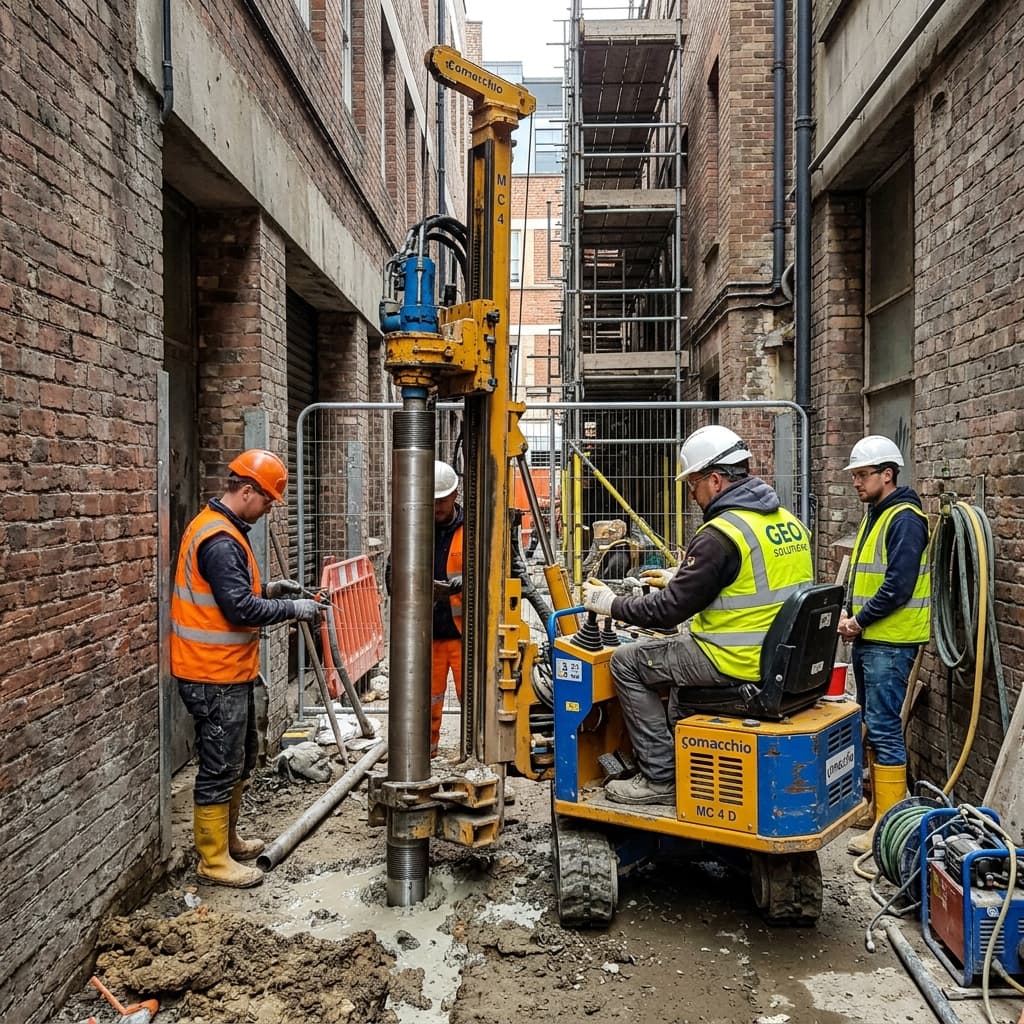
When conventional piers won't work due to tight access or difficult soil, micropiles provide deep foundation support with minimal equipment footprint.
Micropiles (also called mini piles or injection piles) are small-diameter deep foundation elements used when conventional helical piers or push piers can't access the worksite or can't achieve required capacity in the available soil profile.
When Are Micropiles Used?
Limited access situations — Inside existing structures, under low clearances (crawl spaces under 3 feet), through narrow doorways, or on properties where large equipment can't reach.
High-capacity requirements — Where loads are too heavy for standard helical pier diameters.
Rock or very dense soils — Helical piers can't be installed in rock or very dense material. Micropiles can be drilled and grouted through rock.
Seismically sensitive structures — Grouted micropiles provide excellent lateral resistance for earthquake loads.
How Micropiles Work
A small-diameter borehole (typically 3–12 inches) is drilled to the required depth using rotary or percussion drilling equipment. A steel casing or rebar cage is then inserted and the hole is pressure-grouted. The grout bonds to the surrounding soil or rock to develop load capacity in both compression and tension.
Advantages for Southern California
LA's varied geology — from deep alluvial fill to bedrock outcropping — makes micropiles a frequent solution for properties where soil conditions change dramatically over short distances or depths. They're also valuable for hillside properties with limited equipment access.
At PiersPro, we evaluate whether micropiles, helical piers, push piers, or a combination provides the best solution for your specific conditions and budget.