
Push piers are one of the most effective methods for lifting and stabilizing foundations that have settled. Learn how they work and when they're the right choice.
Push piers (also called resistance piers or steel push piers) are a proven deep foundation solution for stabilizing and often lifting settled foundations. They're particularly effective for heavier residential and commercial structures.
How Push Piers Work
Unlike helical piers that are screwed into the ground, push piers are hydraulically driven straight down using the weight of the structure itself as the driving force. Sections of steel pipe are pushed through the unstable surface soils until they reach load-bearing strata (dense soil, gravel, or bedrock).
Once all piers are installed, hydraulic jacks lift the foundation back toward its original elevation, and the loads are transferred to the new deep support system.
Push Piers vs. Helical Piers
The right choice depends on several factors:
| Factor | Push Piers | Helical Piers |
|---|---|---|
| Driving force | Structure weight | Hydraulic torque |
| Best for | Heavy structures | Any weight |
| Soil type | Any (not rock) | Any (not very dense) |
| Access | Requires excavation | Can work in tight spaces |
| New construction | No | Yes |
For most Southern California residential repairs, helical piers are preferred because they work on lighter structures and require less excavation. Push piers are often specified for heavier commercial buildings or where the soil profile suits them.
What to Expect During Installation
Typical push pier installation involves:
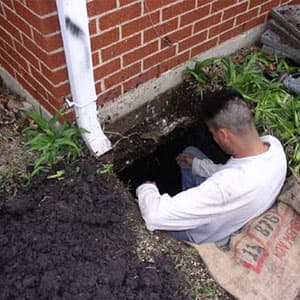
- Excavating to the footing at each pier location
- Attaching steel pier brackets to the footing
- Hydraulically driving pier sections in 4–6 foot increments
- Reaching load-bearing soil (verified by load monitoring)
- Transferring loads and lifting the foundation
- Backfilling and restoring the excavation
Most residential projects are completed in 1–3 days.