
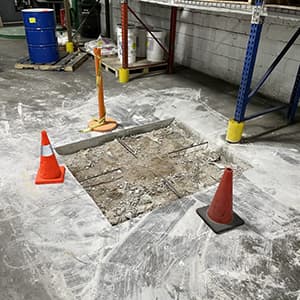
Slab piers stabilize sinking concrete slabs from below — a more permanent solution than mudjacking when underlying soil conditions are the problem.
Table of Contents
Concrete slabs settle when the soil beneath them compresses, washes away, or loses bearing capacity. Mudjacking (filling voids with grout) can temporarily restore level, but if the soil condition itself is the problem, the slab will settle again. Slab piers address the root cause.
How Slab Piers Work
Slab piers are small-diameter steel piers driven through the slab and into stable bearing soil below. Specialized brackets distribute the load from the slab to the pier. Once all piers are in place, the slab can often be lifted back toward its original position and the loads are transferred to the stable deep soil.
When Slab Piers Are Needed vs. Mudjacking
Choose mudjacking when:
- The slab has settled due to a void (no ongoing soil movement)
- The soil beneath is stable — just has a gap
- Cost is the primary constraint
Choose slab piers when:
- The soil itself is compressible or continues to consolidate
- Previous mudjacking has not held
- There is ongoing differential settlement
- The slab supports significant structural loads
Common Applications
- Interior garage slabs
- Basement floor slabs showing differential settlement
- Pool decks and hardscape
- Warehouse and industrial floors
- Stoops and front entries
Our Process
We core small (2–3 inch) holes through the slab at strategic locations, drive slab piers to bearing, attach brackets, and perform a controlled lift. The core holes are then patched with matching concrete. Most jobs are completed in one day.