
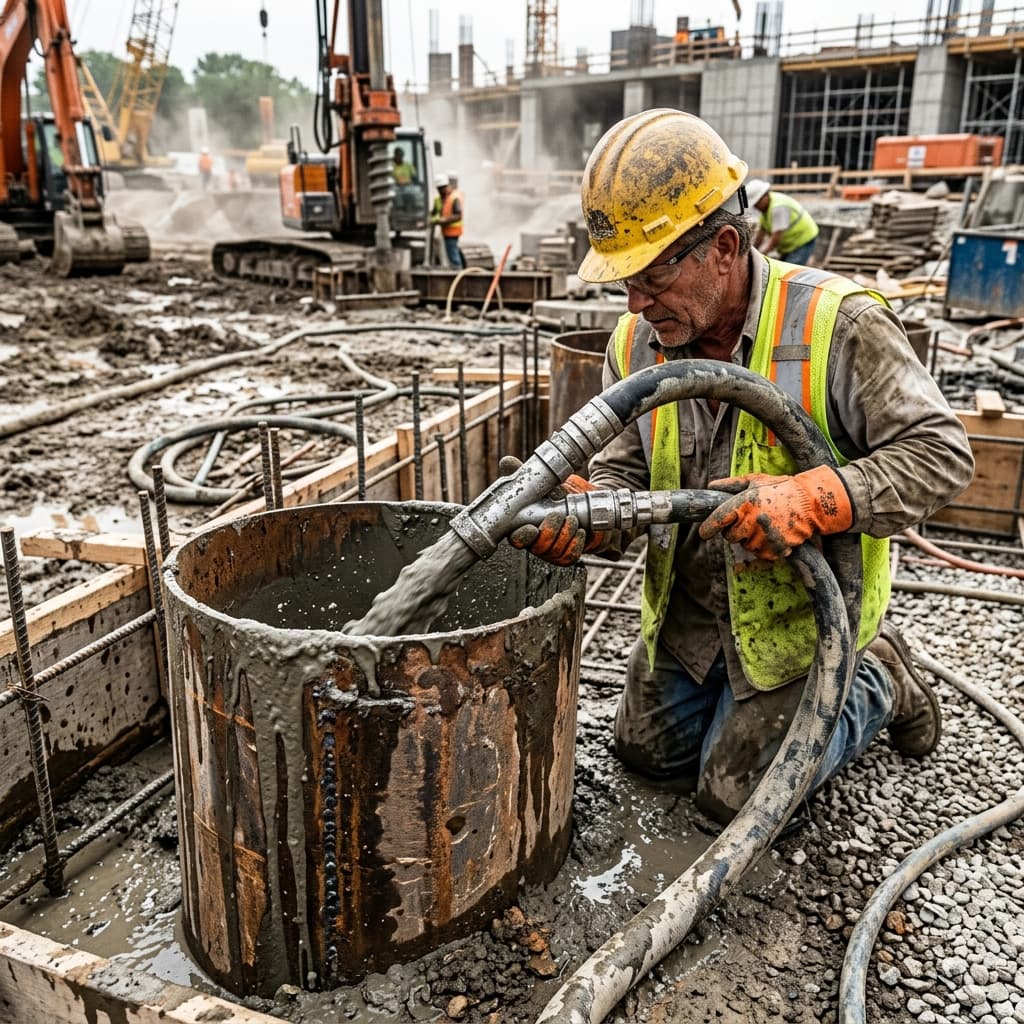
Grouted piles combine steel reinforcement with pressure-injected grout to create high-capacity deep foundation elements — ideal for soft soils and seismically active areas.
Table of Contents
Grouted piles (also called grout-injected piles or CFA piles) use pressure-injected cement grout to bond a steel element to the surrounding soil, dramatically increasing both the axial and lateral capacity compared to ungrouted steel alone.
How Grouted Piles Are Constructed
A borehole is advanced to the required depth. As the drill is withdrawn, grout is continuously pumped through the hollow stem, filling the hole from bottom to top. A steel reinforcing cage or threaded rod is then placed into the fresh grout. As the grout cures, it forms a bond with the surrounding soil along the full pile length.
Advantages in Seismic Zones
Southern California's seismic risk creates demand for foundations with excellent lateral resistance — not just vertical load capacity. Grouted piles excel here because:
- The grout-soil bond creates high lateral (horizontal) resistance
- The full-length bond resists both compression and tension (uplift)
- Grouted piles are compliant with California seismic design requirements
Soft Soil Applications
In areas with deep soft clay or loose sand (common in coastal LA and the San Gabriel Valley), grouted piles can develop capacity that pure steel piers cannot achieve in such materials. The grout effectively enlarges the pile diameter and bonds to weak soils along a long contact length.
When We Specify Grouted Piles
Our engineers specify grouted piles for projects requiring:
- High lateral load capacity (seismic or slope stabilization)
- Pile installation through very soft or loose soils to deeper bearing
- High capacity with smaller visible footprint above grade
- Permanent structural foundation systems on challenging sites