
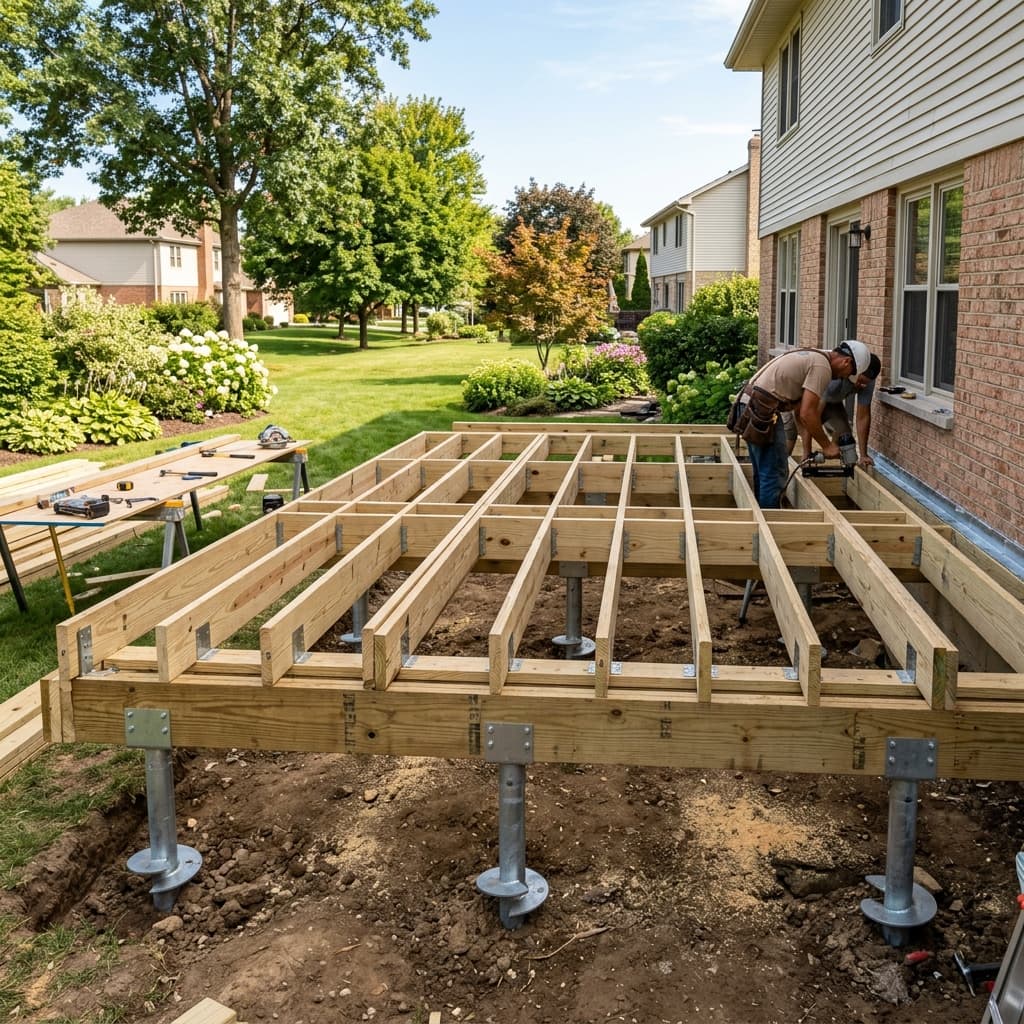
Helical piers aren't just for failing foundations. They're also the smartest way to build a new patio, deck, or outdoor structure that stays level for decades — without a massive concrete pour.
Table of Contents
When most homeowners think about helical piers, they picture heavy equipment stabilizing a sinking foundation. But these versatile steel screw piles are equally valuable for a much more common project: building a new patio, deck, pergola, or outdoor structure on a solid, long-lasting foundation.
Why Patios Sink — and How to Prevent It
Traditional patio foundations rely on either:
- Concrete poured on grade — sits on surface soil, which compacts and shifts with moisture cycles
- Surface footings — shallow concrete pads that heave in freeze-thaw cycles or sink in soft soil
Southern California's expansive clay soils are particularly problematic. The wet-dry seasonal cycle causes the soil to swell and contract, often by 1-2 inches per year. Over time, even a well-poured concrete patio develops cracks, trip hazards, and drainage problems.
Helical piers bypass this problem entirely — they're driven past the active surface soil into stable bearing strata below, anchoring your patio structure to ground that doesn't move.
How Helical Pier Patio Foundations Work
For a new patio or deck, the process is straightforward:
1. Layout & Engineering
We determine pier locations based on the patio design, load requirements, and local soil conditions. A typical patio requires piers every 6-8 feet along the perimeter and at major load points.
2. Pier Installation
Compact hydraulic equipment drives helical piers to the required depth — typically 8-15 feet for patio applications in Southern California. Each pier is torque-monitored to verify bearing capacity.
3. Bracket Attachment
Above-grade steel brackets are welded or bolted to each pier. These brackets connect directly to the patio's structural framing — beams, posts, or ledger board.
4. Structure Assembly
Your patio deck, pergola, or cover is built on top of the pier system. The finished result looks identical to any other patio — the foundation system is completely hidden beneath.
Advantages Over Concrete Footings
Immediate installation and loading — helical piers can be loaded immediately after installation. No curing time. Your contractor can start framing the same day.
Minimal excavation — no digging out large footing holes, no concrete trucks, no waiting for soil compaction. Much faster and cleaner installation.
Adjustable — if settlement ever does occur (rare but possible), helical piers can be adjusted without demolishing the structure.
Works on slopes — hillside patios are a perfect application. Helical piers handle the variable depth requirements of sloped sites without complex grading.
Removable — unlike concrete, helical piers can be removed if you ever want to change the layout. This matters for homeowners who may want to reconfigure their outdoor space.
Ideal Applications in Southern California
- Attached decks and patios on expansive clay soils in LA County and Orange County
- Detached pergolas and shade structures that need to stay level
- ADU patios and outdoor living additions where concrete trucks can't access
- Hillside patios with variable ground elevation
- Pool deck additions where undermining existing concrete must be avoided
- Rooftop decks on residential additions (piers transfer loads to existing structure)
Cost Comparison
For a 300 sq ft patio:
- Traditional concrete footings: $800-1,500 for footings alone, plus excavation, labor, and curing time
- Helical pier foundation: $1,200-2,500 depending on depth and quantity, but with faster installation and no curing delay
The premium is modest — and you get a foundation that's engineered and verified, not just poured and hoped for.
Getting Started
PiersPro provides complete helical pier foundation packages for new outdoor structures — from engineering and permitting to installation and bracket attachment. We work directly with your patio contractor or can recommend trusted partners in the LA and Orange County area.
Contact us for a free site evaluation and pier layout estimate for your patio project.