
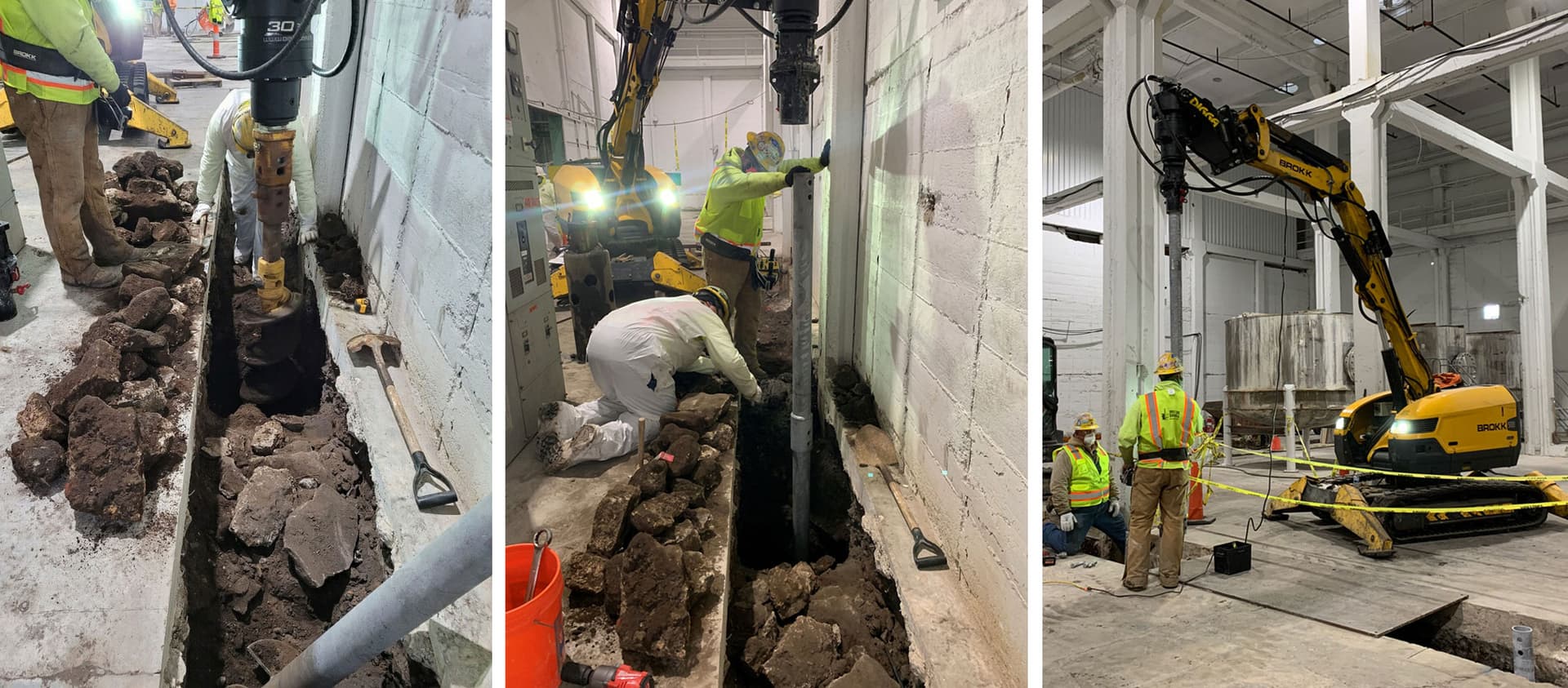
Helical piers have become the gold standard for permanent foundation stabilization. Here's how they work, when they're used, and what makes them superior to older methods.
Table of Contents
Helical piers — also called helical piles or screw piles — have revolutionized foundation repair over the past two decades. They offer something older methods could not: deep, reliable anchoring with minimal excavation and immediate load-bearing capacity.
How Helical Piers Work
A helical pier is a steel shaft with one or more helical (screw-shaped) plates welded at precise intervals. The pier is hydraulically rotated into the ground — literally screwed into the earth — until it reaches stable, load-bearing soil far below the problematic surface layers.
The key metric is installation torque. As the pier advances through soil, we monitor the torque (rotational resistance) continuously. When the torque reaches the required value, we know the pier is anchored in soil strong enough to carry the load. This is backed by empirical research and ICC AC358 standards.
When Helical Piers Are Used
- Foundation settlement — When footings have settled due to soil erosion, moisture changes, or poor original construction
- New construction on poor soil — As primary foundation elements where bearing capacity is inadequate near the surface
- Deck and porch stabilization — For elevated structures showing movement or settlement
- Tieback anchors — To resist horizontal soil pressure on retaining walls
Advantages Over Push Piers and Concrete Piers
Push piers require significant structure weight to drive them — they can't be installed on lightweight or new structures. Concrete piers require large excavations, curing time, and heavy equipment. Helical piers:
- Work on any structure weight (light or heavy)
- Can be installed in confined spaces and tight access areas
- Are immediately load-bearing — no curing time
- Can be installed in any weather
- Produce minimal disturbance to landscaping
Southern California Considerations
LA and Orange County soils present specific challenges: expansive clays that swell with moisture, alluvial sediments of varying density, and hillside conditions with fill over native soil. Our engineers size and specify helical piers for your exact conditions — not a one-size-fits-all solution.