
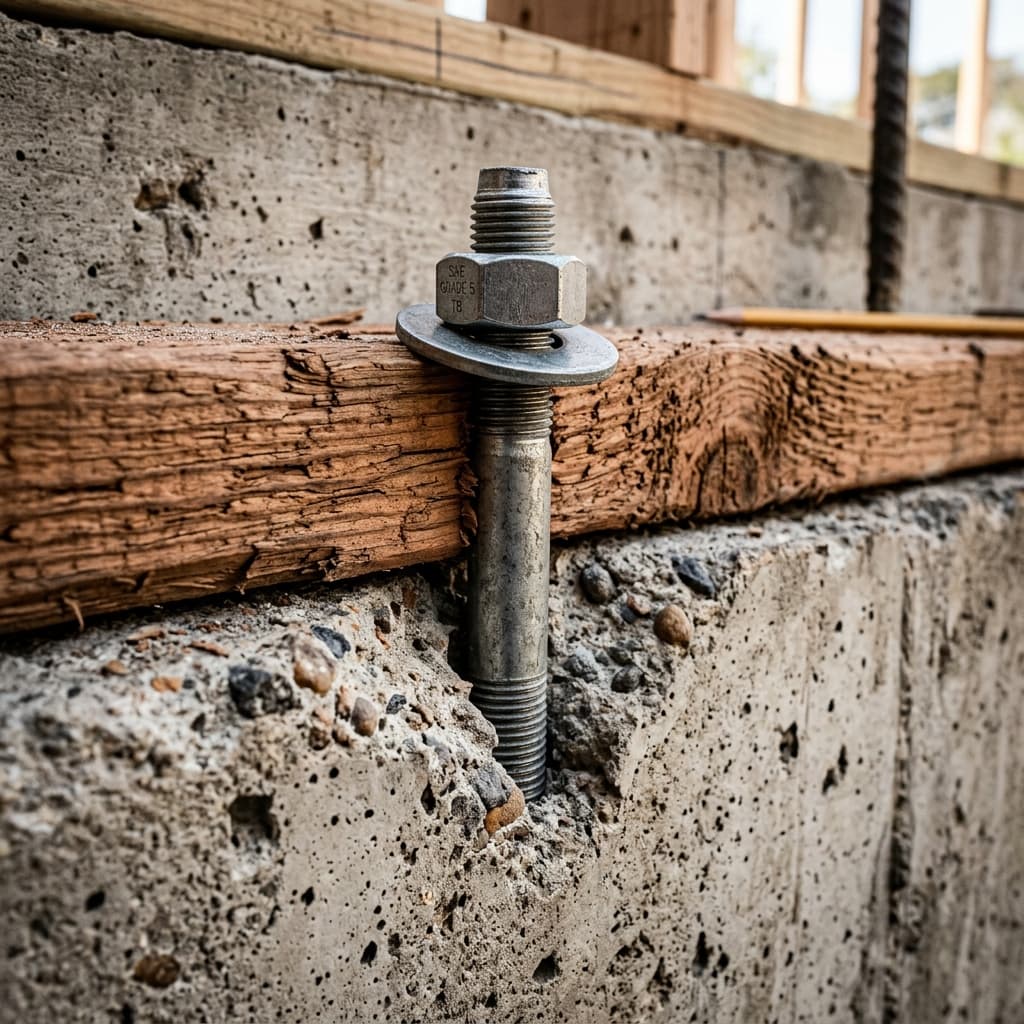
Understand how foundation bolting anchors your wood mudsill to the concrete foundation wall. Learn about expansion vs epoxy bolts, compliance, and costs in Southern California.
Table of Contents
In Southern California, a home's structural integrity rests on a complex load path that transfers the weight of the house down to the earth. For houses built with raised foundations (featuring crawl spaces), the most critical interface in this load path is where the wood framing of the home meets the concrete foundation wall. This interface is the mudsill—the horizontal wood plate that rests directly on top of the concrete.
If your home was constructed before 1980, the mudsill was likely laid on the concrete footing without mechanical anchoring, or secured only with thin nails. During a major seismic event, the lateral forces will cause the wood mudsill to slide off the concrete wall, dropping the house and causing massive, often unrepairable structural damage.
The solution is foundation bolting (also known as sill plate anchoring). In this guide, we will explain how earthquake foundation bolts work, compare the technical specifications of expansion vs. epoxy bolts, and break down foundation bolting costs in Los Angeles and Orange County in 2026.
What is Foundation Bolting?
Foundation bolting is the process of drilling through the wood mudsill into the concrete foundation wall and inserting heavy-duty steel anchor bolts. This mechanically ties the wood framing of your home to its concrete footing, preventing lateral movement during an earthquake.
At PiersPro, operating under California General Contractor License #1110475, we use two types of code-compliant foundation bolts depending on the age and condition of your concrete:
1. Mechanical Expansion Bolts (Wedge Anchors)
Expansion bolts are ideal for homes with modern, structurally sound concrete foundations.
* How they work: We drill a hole through the mudsill and into the concrete footing. We insert the expansion bolt and tighten the nut. As the nut is tightened, a steel sleeve at the bottom of the bolt expands, wedging itself tightly against the walls of the concrete hole.
* Best for: High-density concrete that can withstand the outward mechanical pressure exerted by the expanding sleeve.
2. Chemical Epoxy Anchor Bolts
Epoxy bolts are recommended for older homes (built before 1950) that feature unreinforced or lower-density concrete foundations.
* How they work: We drill the hole and thoroughly clean it using a steel brush and compressed air. We inject a high-strength, two-component structural epoxy adhesive into the hole, and then insert a threaded steel rod. The epoxy cures, bonding the steel rod to the concrete along the entire length of the hole.
* Best for: Fragile, older concrete. Because epoxy anchors do not exert mechanical expansion pressure, they prevent the old concrete from cracking or splitting.
---
Mid-Content Call to Action
Is your mudsill securely anchored, or is your home sitting unbolted?
Don't guess about your home's safety. PiersPro offers a detailed $99 Instrumental Diagnostic where we inspect your crawl space, check mudsill integrity, and verify anchoring. If repairs are needed, we credit the $99 back to your contract.
Book a Diagnostic Inspection or call (213) 583-6669 to speak with our structural team.
---
Comparison: Expansion Bolts vs. Epoxy Anchors
| Technical Metric | Expansion Bolts (Wedge Anchors) | Epoxy Anchor Bolts |
|---|---|---|
| Material | Zinc-plated or galvanized steel | Threaded steel rod + structural epoxy adhesive |
| Primary Soil / Material | Solid, high-density concrete footings | Low-density, older, or unreinforced concrete |
| Mechanical Stress | Exerts outward expansion force inside concrete | Zero expansion stress (bonded adhesive joint) |
| Curing Time | None (can be loaded immediately) | Requires 1 to 24 hours to cure (depends on temp) |
| Seismic Performance | Excellent in strong concrete | Superior in older, historic masonry or weak concrete |
How Much Does Foundation Bolting Cost in 2026?
For a standard single-family home (1,200 to 2,000 sq. ft.) with easy crawl space access, the average foundation bolting cost ranges between $3,000 and $5,500.
Factors that influence the project cost include:
* Accessibility: Extremely tight crawl spaces (under 18 inches of clearance) limit equipment use and require more labor, which increases cost.
* Mudsill Wood Quality: If the mudsill has suffered dry rot or termite damage, we must perform structural wood repairs first.
* Bolt Type: Epoxy anchors are slightly more expensive than expansion bolts due to the cost of the structural epoxy adhesive and additional cleaning steps.
At PiersPro, we operate under a strict "No-Upsell" policy. If your crawl space already has code-compliant foundation bolting, we will tell you during our diagnostic inspection. We only recommend repairs that are necessary for safety and code compliance. You can view photos of our actual crawl space retrofitting projects in our Projects section.
Frequently Asked Questions (FAQ)
Q1: How many foundation bolts does my house need?
A1: Under California Building Code (Chapter A3), foundation bolts must be placed within 12 inches of the end of each mudsill board and spaced no more than 6 feet apart along the perimeter. For homes with cripple walls, the spacing is typically reduced to 4 feet.
Q2: What is the diameter of earthquake foundation bolts?
A2: Code standards require bolts to be at least 1/2-inch in diameter, though 5/8-inch bolts are standard for larger homes or homes with taller cripple walls to provide additional shear strength.
Q3: Can foundation bolting be done from the outside?
A3: In some cases where crawl space clearance is completely blocked, we can saw-cut the exterior stucco to install side-mounted foundation plates (Universal Foundation Plates) and then patch the stucco. However, the standard and most cost-effective method is installing them from the inside.
Q4: How long does the installation process take?
A4: For a standard single-family home, our crews complete the drilling, bolting, and cleanup in 1 to 2 days.
Take Action to Secure Your Foundation
Anchoring your mudsill to the concrete foundation is the single most important step in seismic protection. Trust the specialists at PiersPro to deliver code-compliant, honest craftsmanship.
Contact PiersPro today. Call us at (213) 583-6669 or book your diagnostic online to schedule an inspection.