
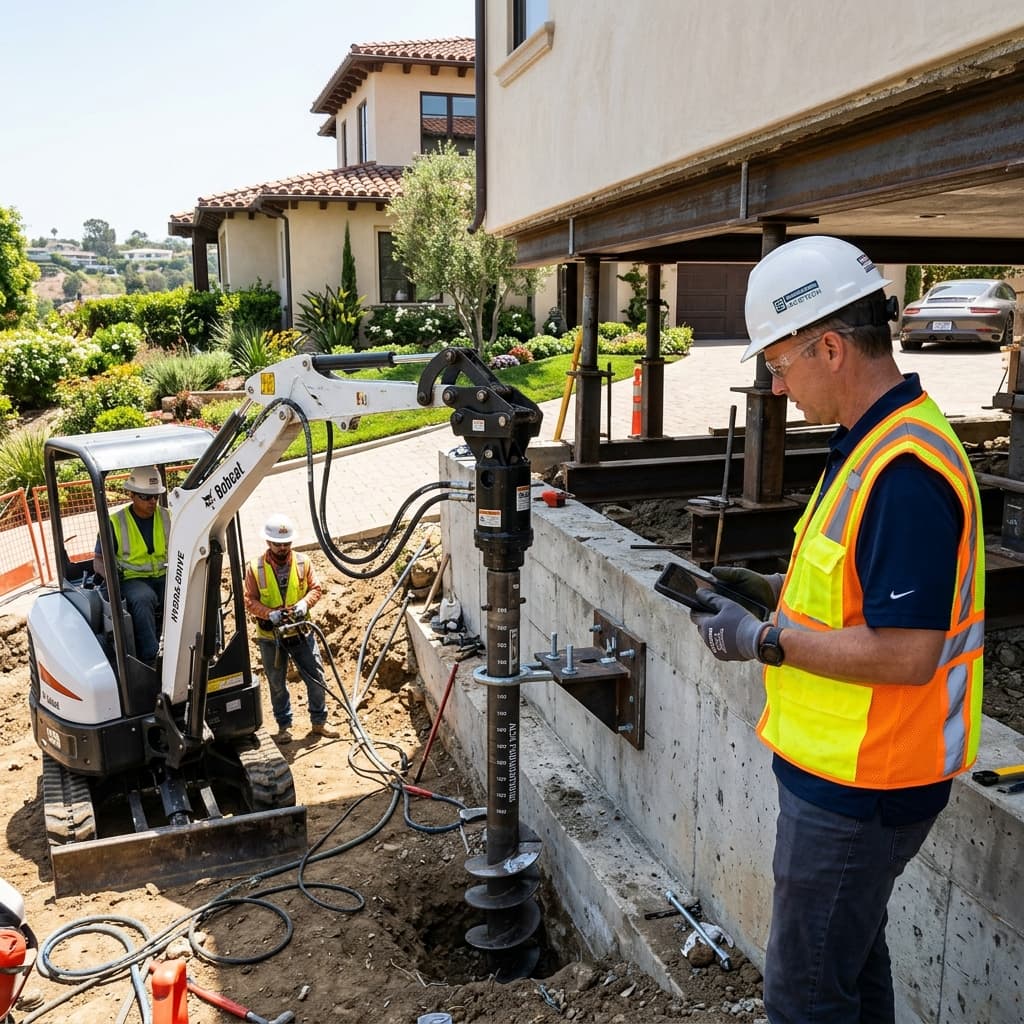
Learn about hillside foundation challenges in Glendale, California. Discover how soil creep affects retaining walls and footings, and learn about repair options.
Glendale features a hilly topography, with many residential properties built on steep slopes in the Verdugo Mountains and San Rafael Hills. While hillside living offers beautiful views, it presents structural challenges, including soil creep, landslides, and retaining wall deterioration.
At PiersPro (CA GC License #1110475), we specialize in hillside foundation stabilization and retaining wall repair in Glendale. This guide explains how to protect your sloping property.
Hillside Stabilization and Soil Creep
Hillside foundations are subject to a natural process called "soil creep," where the top layer of soil slowly moves downhill over time.
* The Risk: If concrete footings are not anchored deep enough into solid bedrock, the foundation will slide or tilt downhill, causing drywall cracks.
* The Solution: We install steel helical piers or micropiles that anchor the home's footings deep into the underlying bedrock, bypass the moving topsoil.
* Retaining Walls: Retaining walls hold back soil on tiered lots. If these walls lack drainage, water pressure builds up behind them, causing them to bow or crack.
---
Mid-Content Call to Action
Is your Glendale home experiencing hillside settlement or retaining wall cracking?
Work with structural specialists. PiersPro offers a detailed $99 Instrumental Diagnostic (credited to your contract) to evaluate slopes and retaining walls.
Schedule a Glendale Inspection or call (213) 583-6669 to speak with our hillside engineering team.
---
Frequently Asked Questions (FAQ)
Q1: What is the Glendale rule for retaining wall permits?
A1: The Glendale Building Division requires a building permit and structural engineering calculations for any retaining wall that is over 4 feet tall (measured from the bottom of the footing to the top of the wall).
Q2: What causes hillside concrete footings to crack?
A2: Diagonal cracks in hillside footings are typically caused by slope failure or soil creep, where the downhill side of the footing loses soil support and settles.