
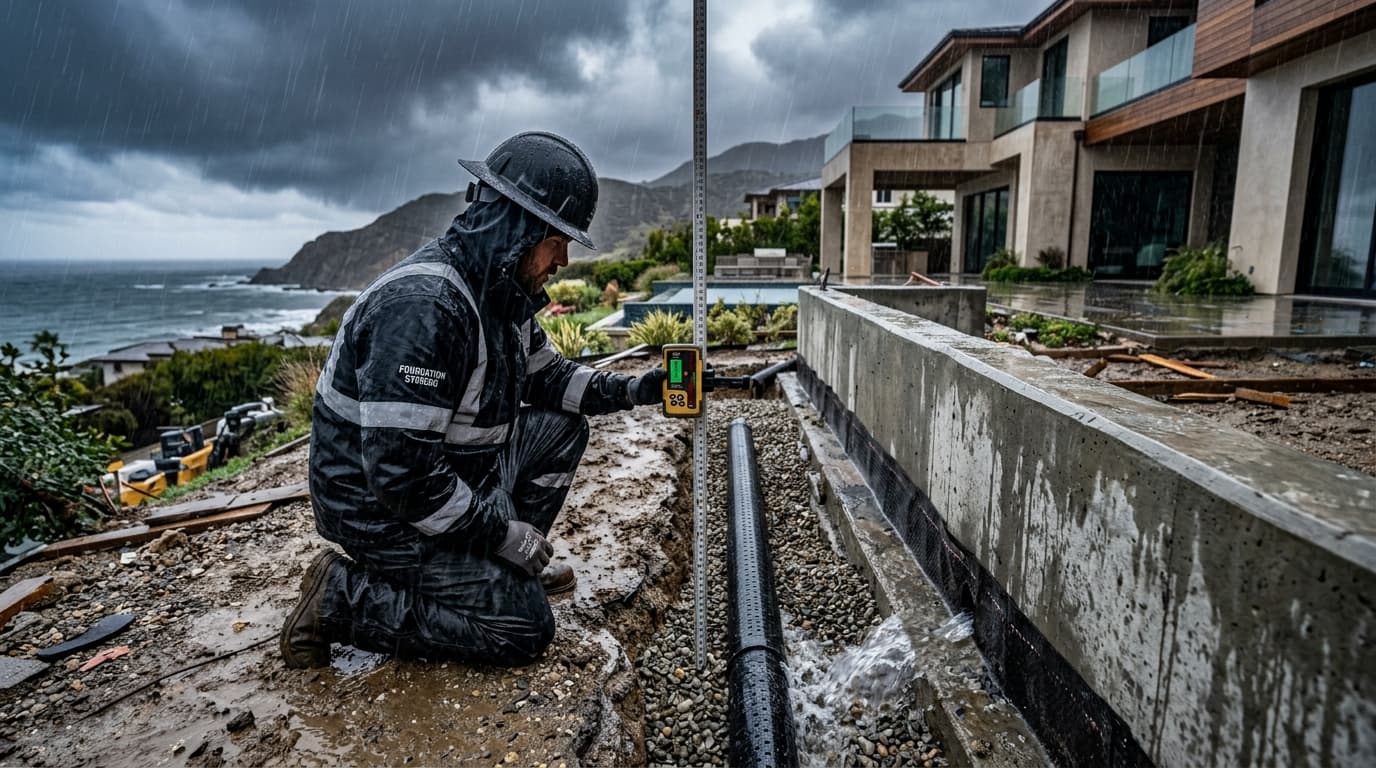
With winter 2026–2027 forecasts warning of aggressive El Niño atmospheric rivers across Southern California, learn how extreme soil saturation threatens foundations and how to protect your home.
Table of Contents
Meteorological models for the winter 2026–2027 rainy season are flashing clear warning signals across Southern California: an active El Niño oceanic cycle coupled with warm Pacific sea-surface anomalies is set to channel an intensified corridor of atmospheric rivers directly into Los Angeles, Orange County, and surrounding coastal and foothill valleys.
For local homeowners, this seasonal forecast represents far more than temporary inconvenience or traffic delays. In our semi-arid climate, multi-day torrential downpours rapidly super-saturate drought-hardened soils, triggering severe structural challenges. As Dmitrii, licensed General B Contractor (CSLB #1110475) and lead structural specialist at PiersPro, I urge property owners to understand the geotechnical physics at play and fortify their structural envelopes before winter storms make landfall.
The Geotechnical Threat: Expansive Clay & Hydrostatic Pressure
Most homes across Los Angeles and Orange County are built on expansive smectite or adobe clay soils. During prolonged summer and autumn dry spells, these soils shrink, consolidate, and develop deep subterranean fractures. When a sequence of back-to-back atmospheric rivers delivers 4 to 8 inches of torrential rainfall over 48 hours, several destructive physical processes occur simultaneously:
- Severe Volumetric Soil Swelling: Water infiltrates deep fissures, causing clay soils to expand by up to 20% to 25% in volume. This upward heave places enormous uneven stress on concrete slab-on-grade floors and perimeter stem walls.
- Lateral Hydrostatic Surcharge: Water weighs 62.4 pounds per cubic foot. When subterranean runoff is trapped against an unsealed foundation or hillside retaining wall, lateral hydrostatic pressure can peak at over 3,000 lbs per square foot. Pressurized groundwater forces its way through concrete cold joints, plumbing penetrations, and hairline fissures.
- Soil Shear Failure & Footing Sinkage: Once the subgrade reaches 100% saturation, the clay liquefies into a low-shear slurry. Without frictional bearing support, heavy concrete footings begin to sink unevenly, causing stair-step foundation cracks, sloping interior floors, and jammed doors.
Review our comprehensive El Niño Storm Defense Protocol for an interactive vulnerability breakdown of your specific foundation and subgrade type.
Critical Pre-Storm Foundation Hardening Measures
Homeowners can avoid catastrophic structural settlement by taking proactive steps ahead of winter storms:
- Inspect Exterior Soil Grading: Ensure perimeter landscape mulch and soil sit at least 4 to 6 inches below your stucco weep screed. Soil mounded over weep screeds funnels rainwater directly into interior sill plates and wall cavities.
- Extend Roof Downspouts: Never allow roof downspouts to dump water adjacent to foundation footings. Install rigid or corrugated discharge extensions that route concentrated roof runoff a minimum of 8 to 10 feet away from the home.
- Clear Perimeter Drainage Paths: Verify that landscape swales, surface channel drains, and catch basin grates are completely free of leaves, roots, and silt deposits.
- Check Crawlspace Access Wells: Inspect subterranean crawlspaces with a flashlight for early signs of dampness, efflorescence (white mineral powder on concrete), or standing puddles.
Engineered Solutions: French Drains, Underpinning & Crystalline Sealing
When natural surface drainage is insufficient to protect against rising winter water tables, engineered structural interventions are required:
1. Commercial Subterranean French Drain Networks
Builder-grade 3-inch corrugated pipes frequently collapse or clog under heavy silt loads. PiersPro designs and installs commercial-grade drainage systems utilizing 4-inch to 6-inch perforated smooth-interior N-12 pipes surrounded by washed crushed rock and non-woven geotextile filter fabric to intercept and redirect groundwater safely away from footings.
2. High-Pressure Crystalline Waterproofing Injection
Rather than applying temporary topical rubber sealants that fail under hydrostatic head pressure, we utilize advanced crystalline waterproofing compounds (such as Xypex technology). These chemical agents react with moisture and un-hydrated cement particles to grow millions of microscopic insoluble crystals deep within concrete pores, permanently blocking water entry even under extreme pressure.
3. Helical Pier Underpinning for Saturated Soils
If your home is experiencing differential settlement due to waterlogged subgrade failure, helical piers provide permanent structural stabilization. Hydraulically rotated deep beneath the unstable mud into dense load-bearing bedrock or strata 15 to 40+ feet below, helical piers transfer your home's structural weight completely off vulnerable seasonal soils.
Schedule Your Pre-Winter Instrumental Foundation Evaluation
Don't wait for floodwaters to compromise your home's structural integrity. PiersPro provides professional foundation inspections starting from just $99 (visual) or comprehensive instrumental laser level evaluations from $250—with 100% of inspection fees credited directly toward any required repairs.
Call our licensed team directly at (213) 583-6669 or request your inspection online today.