
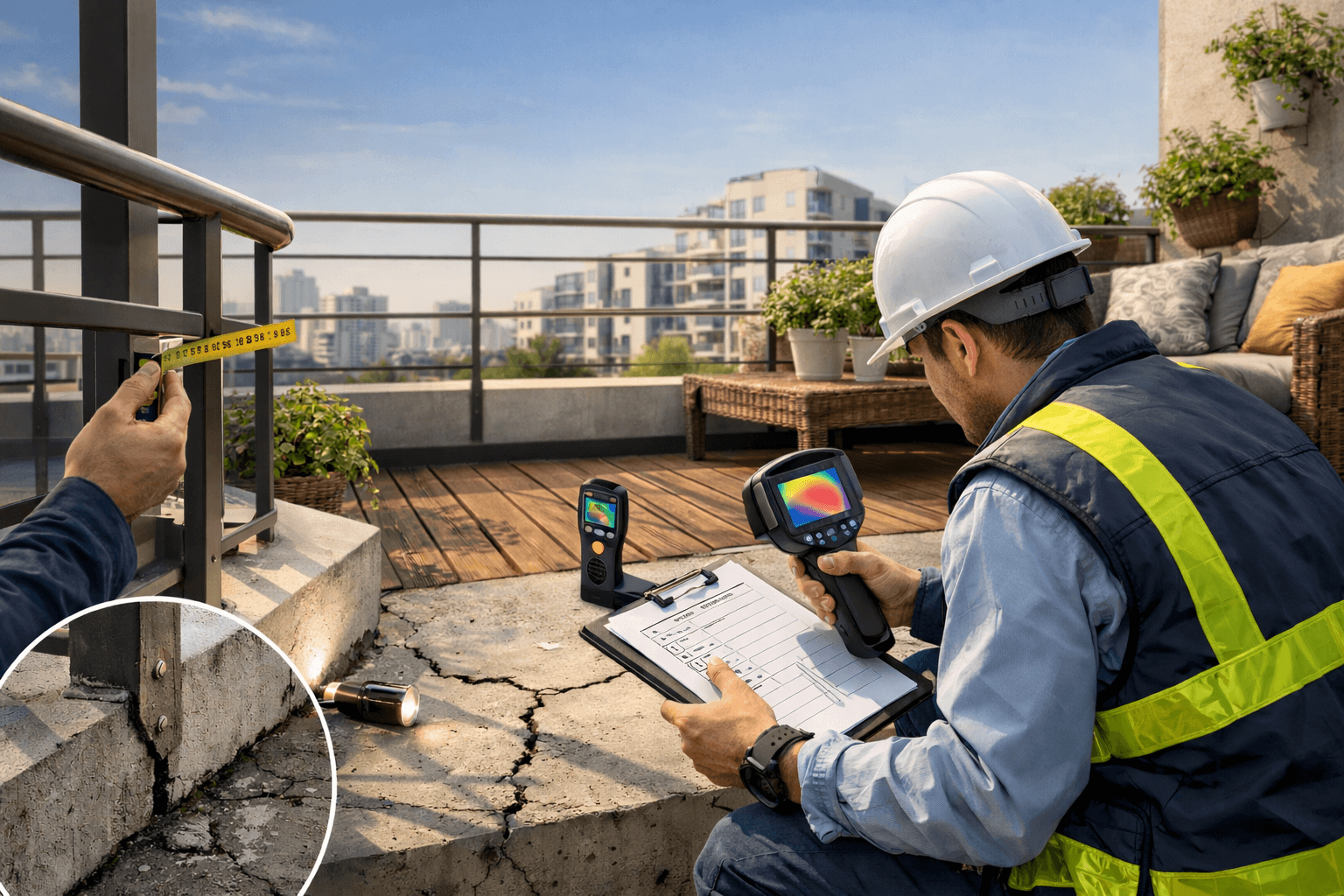
Everything California apartment building owners need to know about Senate Bill 721 (Health & Safety Code §17973): compliance requirements, inspection timelines, who qualifies to inspect, penalties, and required structural repairs.
Table of Contents
- 1. Which Buildings and Elements Fall Under SB-721?
- 2. Who Qualifies to Perform an SB-721 Inspection?
- 3. How the SB-721 Inspection is Conducted
- 4. What Does the Official Compliance Report Contain?
- 5. Compliance Deadlines & Mandatory Repair Timelines
- 6. The Consequences of Non-Compliance in 2026
- 7. California Regulatory & Professional Scope Disclosure
- Schedule Your SB-721 Inspection with PiersPro
For owners, landlords, and property management companies operating multi-family residential buildings in California, balcony safety is no longer a matter of casual property maintenance—it is a strict statutory mandate. Under California Senate Bill 721 (SB-721), codified under Health & Safety Code §17973, property owners are legally required to perform periodic safety inspections of exterior elevated elements (EEEs) to prevent catastrophic structural failures.
Following the tragic 2015 Berkeley balcony collapse, investigations revealed that unseen dry rot within enclosed stucco soffits had completely destroyed the load-bearing timber joists. In response, California lawmakers enacted SB-721 to establish rigorous, enforceable safety protocols across the state.
At PiersPro (holding California General Contractor License CSLB #1110475 — Class B General Building), we conduct certified SB-721 inspections and execute structural repairs across Los Angeles and Orange County. This guide outlines everything property owners must understand to achieve and maintain compliance.
---
1. Which Buildings and Elements Fall Under SB-721?
SB-721 specifically targets multi-family residential rental buildings containing three or more dwelling units. Single-family residences, duplexes, and condominiums (which fall under SB-326) are exempt from SB-721.
What are "Exterior Elevated Elements" (EEEs)?
Under Health & Safety Code §17973, an exterior elevated element is defined as any structure that satisfies all three of the following criteria:
- Elevated Location: Sits more than six feet above ground level (measured from the top of the walking surface to the ground or floor below).
- Pedestrian Use: Designed for human occupancy or pedestrian access, including balconies, decks, porches, exterior stairways, walkways, landings, and entryways.
- Wood Structural Supports: Relies in whole or in part on wood or wood-based structural framing, outriggers, beams, posts, or ledger boards.
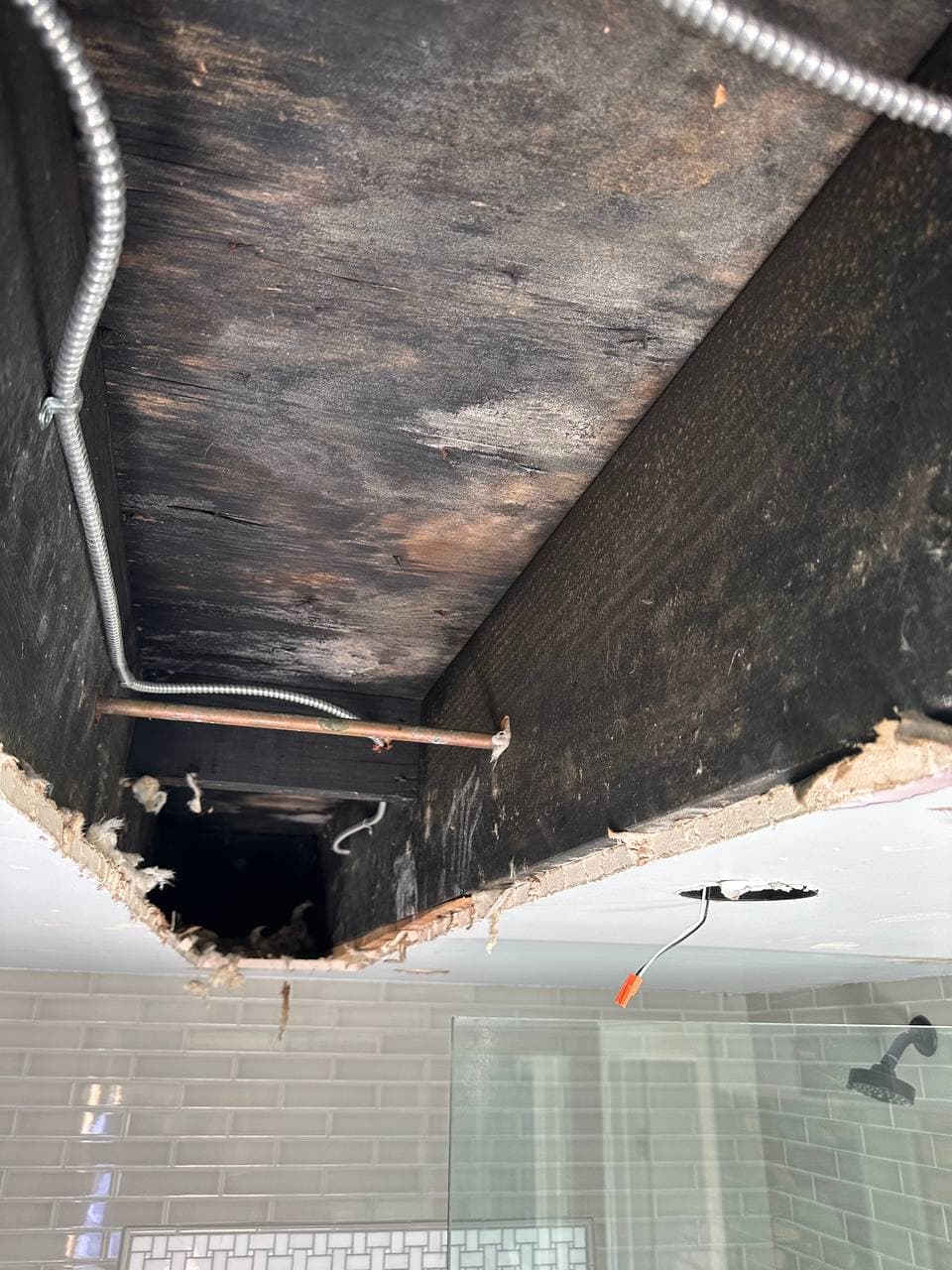
If your building contains elevated balconies constructed entirely of poured-in-place concrete over structural steel I-beams without any wood elements, it is generally exempt. However, if a concrete deck rests on cantilevered wood outrigger joists, it must be inspected under the law.
---
2. Who Qualifies to Perform an SB-721 Inspection?
California Health & Safety Code §17973 establishes specific credential standards for who can legally conduct an SB-721 inspection:
* A Licensed General Building Contractor (Class B) holding an active license issued by the California Contractors State License Board (CSLB) with at least five (5) years of relevant experience constructing or inspecting multi-story building frameworks.
* A Licensed Architect registered with the California Architects Board.
* A Licensed Civil or Structural Engineer registered with the California Board for Professional Engineers, Land Surveyors, and Geologists.
* A Certified Building Inspector holding valid certification from a recognized national code organization (such as ICC).
Important Licensing Note: PiersPro is a licensed General Contractor (CSLB License #1110475 — Class B General Building) with extensive structural repair experience and is fully authorized under Health & Safety Code §17973 to perform SB-721 apartment inspections.
---
3. How the SB-721 Inspection is Conducted
Visual surface inspection alone is legally insufficient and technically unreliable. Because most California balconies are encased in exterior stucco or soffit cladding, wood decay typically occurs hidden inside the framing cavity.
The 15% Statistical Sampling Rule
The inspector must evaluate a statistically significant sample of exterior elevated elements, defined by statute as at least 15% of each type of element across the property (e.g., 15% of cantilevered balconies, 15% of exterior walkways, and 15% of exterior stairs).
Diagnostic Testing Methods:
- Direct Visual Examination: Inspecting deck coatings, slopes, railings, threshold flashing, and water stains.
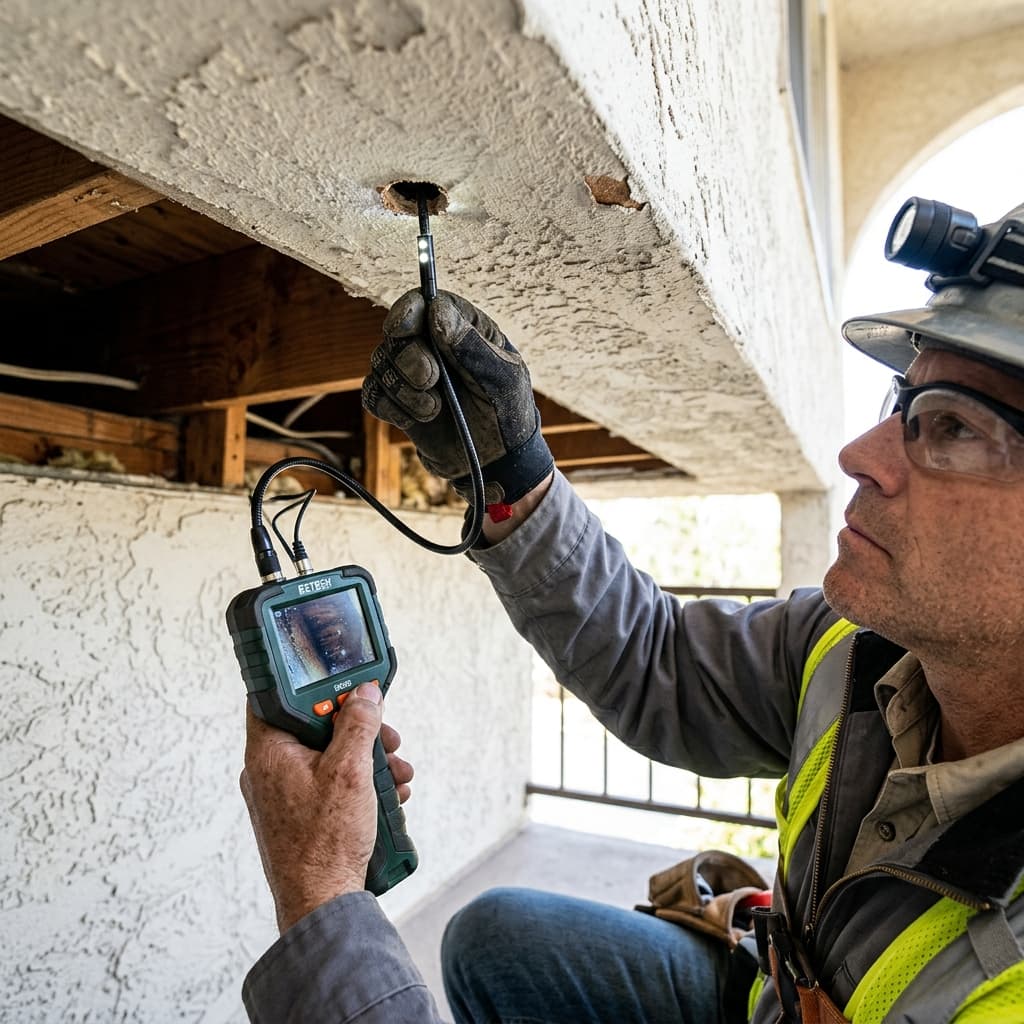
- Minimally Invasive Borescope Inspection: Drilling small, discreet 1/2-inch inspection ports on the underside stucco soffit and inserting a high-definition digital borescope camera to inspect hidden wood joists, ledger connections, and fasteners.
- Digital Moisture Mapping: Measuring moisture content inside the framing. Wood with moisture content exceeding 19% is at immediate risk of fungal dry rot decay.
- Patched & Ventilated Soffits: Following inspection, holes are sealed with paintable, breathable soffit vents, which improves internal air circulation and reduces future dry rot risk.
---
4. What Does the Official Compliance Report Contain?
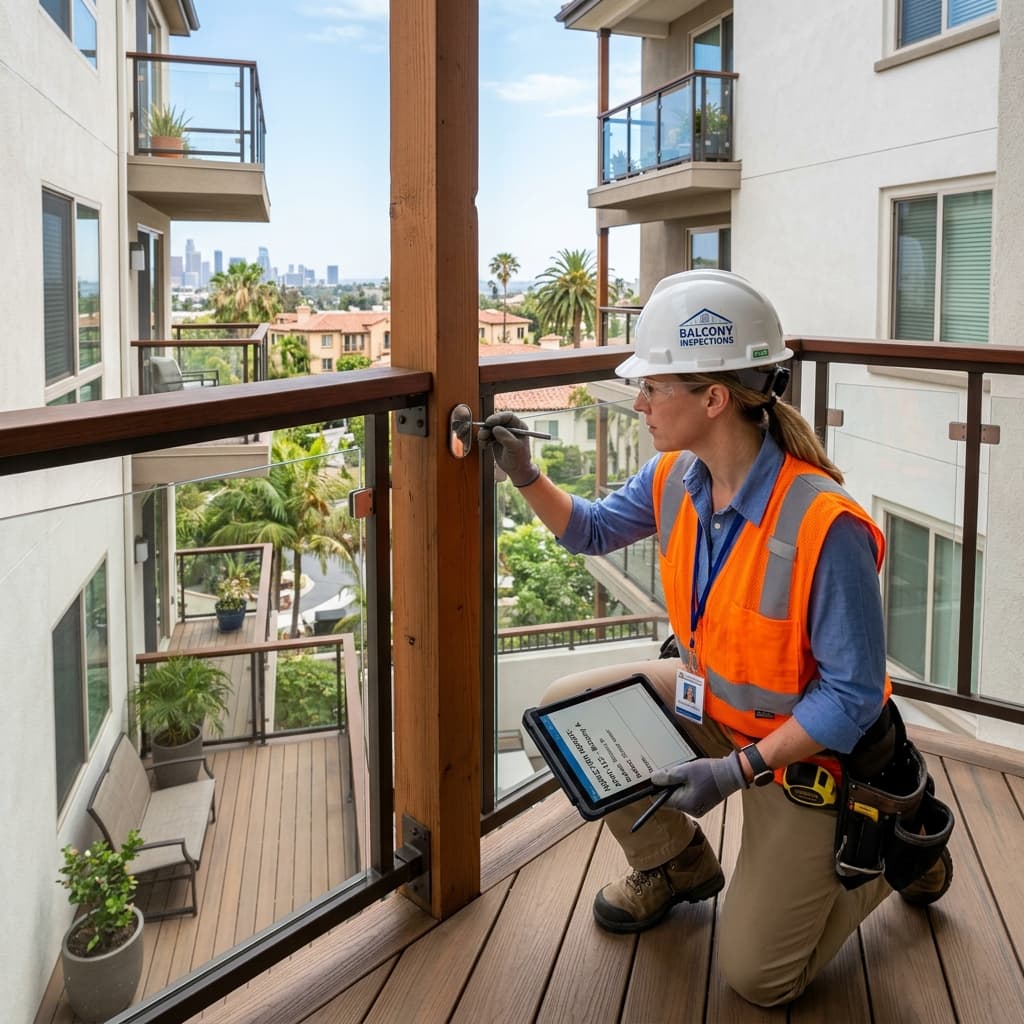
Following the inspection, the inspector must issue a written report stamped and signed by the licensed professional. The report documents:
* Identification of all inspected exterior elevated elements.
* Current structural condition and expectations for future service life.
* The integrity of waterproofing systems, flashings, and surface drainage.
* Identification of any compromised load-bearing elements, dry rot, termite decay, or loose guardrails.
* Classification of findings into Emergency Hazards or Non-Emergency Deficiencies.
---
5. Compliance Deadlines & Mandatory Repair Timelines
The initial statutory compliance deadline for SB-721 was January 1, 2025. For buildings that missed this deadline, inspections are required every six (6) years thereafter. Properties that have not yet recorded an inspection are currently in active code violation.
If Deficiencies Are Found:
| Severity Level | Building Dept. Notification | Permit Application Deadline | Construction Start Deadline |
|---|---|---|---|
| Immediate Hazard (Emergency) | Within 15 days of inspection | Immediate emergency shoring | Immediately upon hazard identification |
| Non-Immediate Hazard (Standard) | Not required to report unless unrepaired | Within 120 days of report delivery | Within 30 days of permit issuance |
For Immediate Hazards (conditions presenting an imminent threat to life safety, such as a sagging console beam or rotted railing), the building owner must immediately restrict resident access, install temporary shoring, and begin emergency repairs.
---
6. The Consequences of Non-Compliance in 2026
Failing to comply with SB-721 carries severe financial and legal liabilities:
* Daily Administrative Fines: Local municipal building departments (including LADBS in Los Angeles and Orange County agencies) can assess civil penalties of $100 to $500 per day until compliance is recorded.
* Safety Liens on Real Property: Unpaid city penalties can be converted into a formal safety assessment lien recorded against the property title, preventing property sales or refinancing.
* Insurance Non-Renewal & Policy Exclusions: Commercial general liability insurance carriers now routinely require a certified SB-721 compliance report during policy renewals. Without one, carriers may deny coverage or exclude exterior balcony injury claims entirely.
* Severe Personal & Civil Liability: If a balcony fails and the owner failed to comply with state inspection mandates, the owner faces catastrophic civil lawsuits with potential punitive damages and charges of criminal negligence.
---
7. California Regulatory & Professional Scope Disclosure
Official Statutory Notice:
SB-721 inspections are performed under California Health & Safety Code §17973 by a licensed general building contractor with more than five years of relevant experience. SB-326 inspections under California Civil Code §5551 must be performed by a licensed structural engineer, civil engineer, or architect. We do not perform SB-326 inspections; we execute the repairs identified in the inspecting professional's report and manage the project on the association's behalf. When you work with PiersPro, we coordinate and provide a licensed engineer for your project, so you do not need to search for one yourself. We do not provide structural engineering services directly. Evaluations of structural capacity, load analysis, and stamped design documents are prepared by a licensed engineer.
---
Schedule Your SB-721 Inspection with PiersPro
At PiersPro, we provide apartment owners with honest, transparent, and certified balcony compliance evaluations. We follow a strict "No-Upsell" policy: if your balconies are structurally sound and watertight, we issue a clean compliance report valid for 6 years. If structural dry rot or framing damage is uncovered, our licensed crews provide turnkey balcony structural repair and waterproofing solutions with closed city permits.
Protect your tenants, eliminate your liability, and secure full compliance today.
Call (213) 583-6669 or Book Your SB-721 Balcony Inspection online.