
Drainage that sends water away from your home
Every drainage system solves one kind of water problem. Pick where your water comes from and we will show you the system that fits.
On-site inspection from $99, credited toward repair.

Where is the water coming from?
Six systems, six different jobs
Start with the water, not the product. Roof water, surface water and groundwater each need their own pipe.
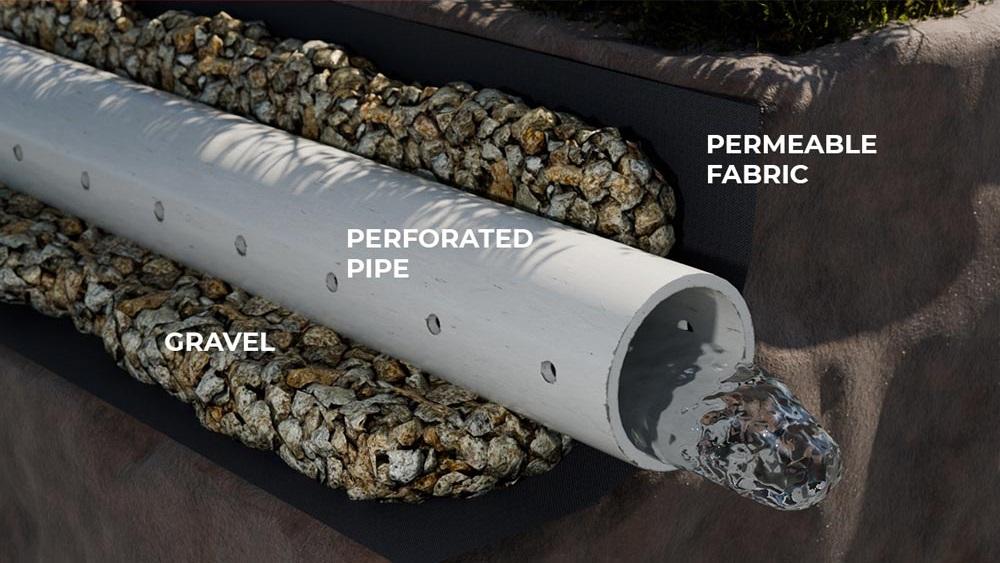
- French drainLowers elevated water tables, relieves hydrostatic pressure on foundations and footings, and permanently eliminates soggy yard dampness with a clog-free gravel envelope.Groundwater
- Downspout drainageSeals and conveys high-volume roof stormwater away from foundations through heavy-duty solid PVC SDR-35 mainlines, stopping footing erosion, stucco rot, and waterlogged soil.Roof water
- Catch basinCollects surface water at the low point and drops it into a pipe, with a sump to trap sand and leaves.Surface water
- Channel drainCatches water across a driveway, patio, pool deck or garage door before it crosses the threshold.Surface water
- Dry wellSubterranean infiltration basin that captures high-volume stormwater from roofs, driveways, and sump pumps, safely recharging it into the subsoil when gravity runoff is impossible.Roof water
- Sump pump stationAutomatic pressurized stormwater and groundwater evacuation for zero-fall and negative-slope properties where gravity discharge is physically impossible.No fall
Gravity first, pump when you must
If water can leave by gravity, use gravity. If there is no fall, build a reliable pump station.
A pump station makes sense when:
- The yard is a bowl. It sits below neighboring lots or the street.
- There is no fall. Too little drop to keep a pipe clean.
- The outlet is high. The storm drain or curb is above the problem area.
Common pump problems and what we do about them
| Problem | Why it happens | What we do |
|---|---|---|
| Pump burns out | A cheap float switch jams in silt | Vertical magnetic level sensor and an accessible basin |
| Pump cycles constantly | No check valve, so water drains back into the basin | Spring check valve on the discharge line |
| No pumping in a power outage | Storms often knock out power at the peak | Battery backup or a second pump |
| Discharge clogs | Leaves or debris block the outlet | Screened outlet on a gravel pad |
The pipe decides how long it lasts
The price gap between pipe types is small next to digging the yard up a second time.
| Pipe | What it is | Where we use it |
|---|---|---|
| PVC SDR-35 or Schedule 40 | Smooth wall, sealed joints, can be jetted or cabled clean | Downspout lines and trunk lines |
| Dual-wall HDPE (N-12) | Corrugated outside for ring stiffness, smooth inside | Larger lines (6 in. and up) and vehicle loads |
| Thin corrugated pipe | Ribs slow the flow, and the pipe crushes and silts up | Not used on primary lines |
What goes into the price
Every yard is different, so the estimate lists each item.
- Length and depth
- A shallow downspout trench and a deep groundwater trench are very different jobs.
- Rock and fabric
- Clean washed rock and good fabric keep the system open for years.
- Access and obstacles
- Concrete cutting, tree roots, irrigation lines and utilities add time.
- Pump station
- Basin, pump, check valve, discharge line and the electrical run.
- Haul-off
- Rock takes the place of the soil we dig out. The extra clay has to leave the site.
A French drain starts from $25 to $38 per linear foot. Other systems are priced after an on-site look. The inspection starts at $99 and is credited toward repair. Add-ons such as a crawl space check or a written report are priced by the calculator on the inspection page.
Typical packages
| Package | Includes | Fits |
|---|---|---|
| Downspout package | Smooth solid line from every downspout, catch basins with a sump, discharge to the street or a permitted outlet | Foundation is dry, but water pools under the gutters |
| Soggy yard package | Trench graded with a laser level, filter fabric, washed rock, perforated pipe with cleanouts | Wet soil, moss, standing water after rain |
| Low lot package | Surface and subsurface collection, sump pump station with check valve, pressure line to the street | No fall, or a yard lower than the street |
Eight mistakes we fix most often
Most failed drains share the same few causes.
- Roof water in a French drain
- You send roof runoff to the foundation instead of away from it.
- Dirty rock
- Fines clog the fabric and the drain stops draining.
- Pipe laid by eye
- Low spots collect silt and hold water.
- No cleanouts
- In five years nobody can flush the line without digging up the yard.
- Pump without a check valve
- Water runs back and the pump cycles itself to death.
- Pipe too small
- Several downspouts on one thin line overflow in the first heavy storm.
- Unsealed joints on a solid line
- Roof water leaks out at the joints, right beside the foundation.
- Grade still slopes toward the house
- The drain cannot keep up when the soil keeps sending water to the wall.
Drainage questions
What is the difference between a French drain and a channel drain?
A French drain collects groundwater through perforated pipe in a rock-filled trench. A channel drain sits at the surface and catches water running across paving. Many yards need both, with the pipes kept separate until the outlet.
How much does yard drainage cost?
It depends on length, depth, access and whether a pump is needed. A French drain starts from $25 to $38 per linear foot. Other systems are priced after an on-site look, and the written estimate lists every item.
Do I need a permit?
Many cities require a permit when work discharges to the street or sits near a retaining wall or slope. We check your city’s rules before design.
Can drainage fix a cracked foundation?
Drainage removes one common cause of movement, which is water. It does not repair existing cracks or settlement. We inspect the water and the structure together so the repair fits the cause.
What does the on-site inspection include?
The inspection starts at $99 and is credited toward repair if you go ahead. It covers visible grading, downspouts, low spots and signs of water at the foundation. Add-ons are priced by the calculator on the inspection page.
Start with an on-site drainage inspection
Good drainage starts with knowing which way your water moves. On every visit we shoot levels across the lot with professional equipment and map the elevations of your site. We use those numbers to design the pipe, its fall and the outlet, then price the job line by line. Led by a California Licensed General B Contractor (Lic #1110475).
- Level shots across the lot with professional leveling equipment
- An elevation map of your site, built for our own design calculations
- Itemized estimate based on measured fall, not guesswork
- The full $99 is credited toward the work if you hire us
Licensed General Contractor #1110475 (Class B, C-10). Requirements vary by city. Check your city’s building department for local rules.