Diagnostic Guide

Is Downspout Drainage Right for Your Home?

The order matters. Identify your symptoms, verify property fit, and explore tailored drainage alternatives.

Signs the system is needed⚠️ Warning Signs

Signs You Need It

  • Soil erosion, washouts, and settlement beneath concrete foundation footings
  • Water splash marks, peeling stucco, and corroded wire lath along the lower walls
  • Spongy, waterlogged turf and flooded walkways around the house perimeter
  • Damp crawl spaces, musty odors, and efflorescence on foundation stem walls
Where the system fits✔ Perfect Match

Where It Fits

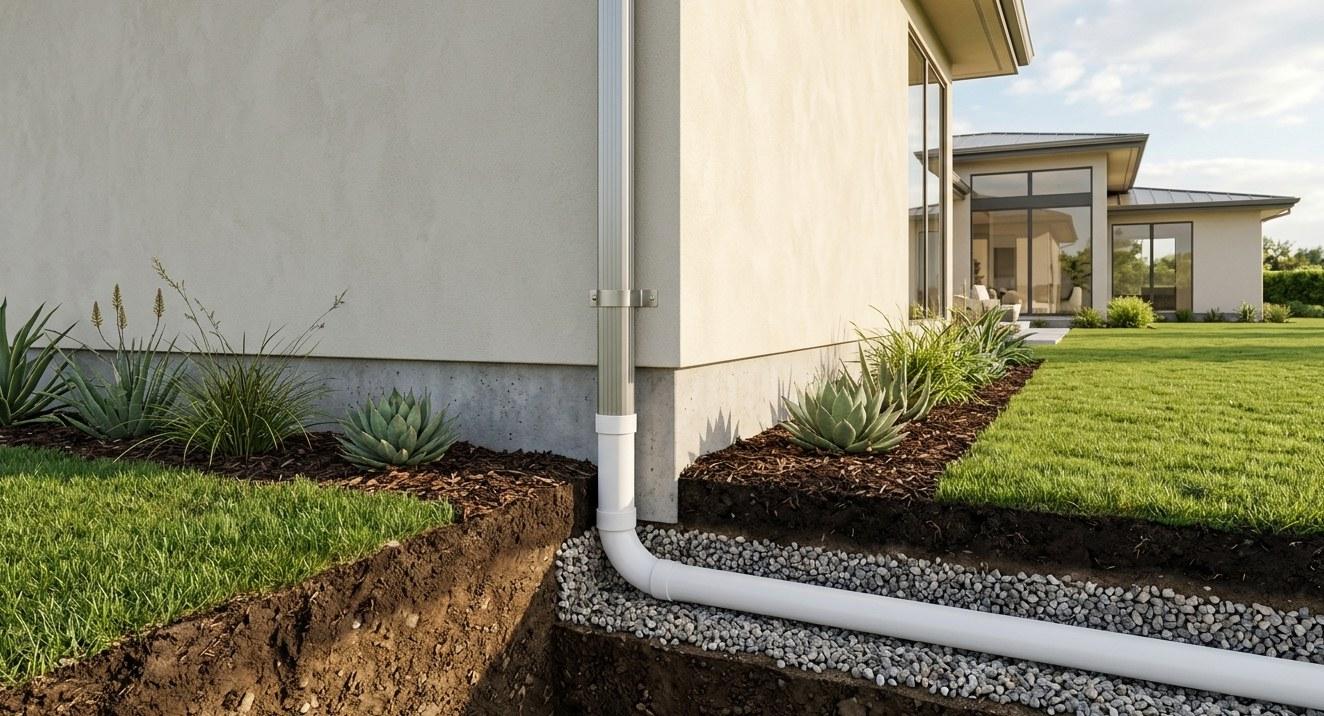
  • Houses where downspouts empty onto soil, splash blocks, or damaged flexible hoses
  • Properties requiring 6-inch mainline transitions to handle torrential atmospheric river downpours
  • Systems combining leaf filter cleanouts with pop-up emitters or gravity curb daylighting
  • Dual-purpose trenches routed past yard low points with integrated surface catch basins
Alternatives

Where It Does Not Fit

Subsurface groundwater rising from soil (use an in-ground perforated French drain) · Bowl-shaped sunken yards with no gravity outlet to the street (use a sump pump station)

💧 Groundwater Issue?

Downspout pipe only handles roof water. High water tables require an in-ground gravel filter.

Explore French Drains ➔
⛔ No Fall / Bowl Lot?

Gravity can't move water uphill. Sunken yards require mechanical lift evacuation.

Explore Sump Pump Stations ➔

How we build it

The order matters. Each step sets up the next one.

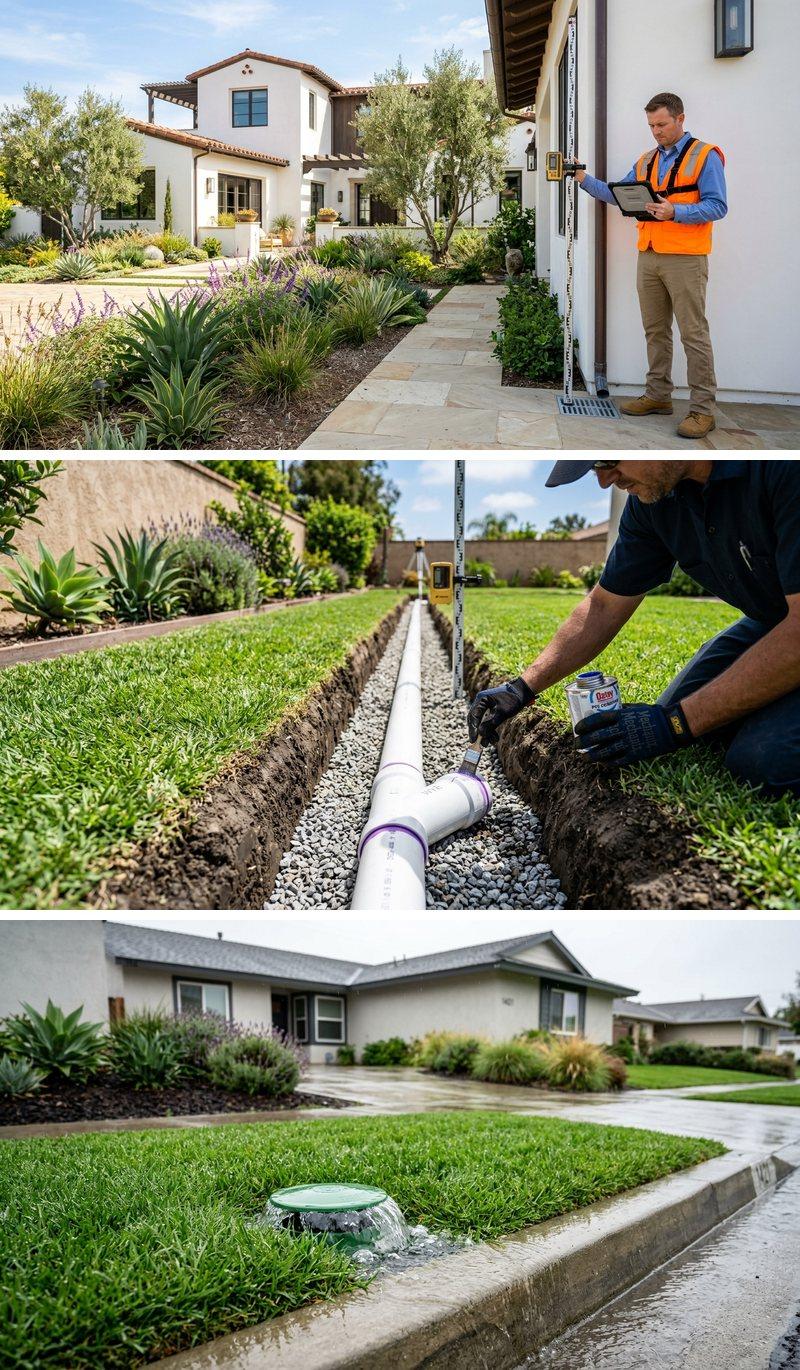
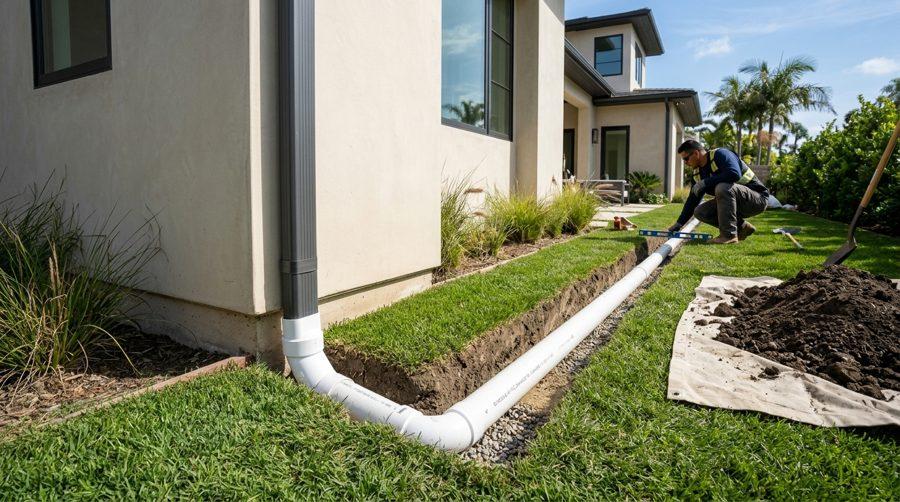
  1. Calculate roof catchment & laser grade fallWe calculate roof square footage per downspout, sizing 4-inch branch lines and stepping up to a 6-inch mainline with a guaranteed 1% to 2% laser-benchmarked slope.
  2. Install leaf filter cleanouts at every dropInline leaf and debris filters are installed at every downspout base to catch leaves, twigs, and asphalt shingle grit before water enters the underground pipe.
  3. Trenching with combo wyes & 45° sweepsTrenching avoids utilities and tree roots. All directional turns and lateral tie-ins use 45-degree fittings and combination wyes to maintain high flow velocity without clogs.
  4. Solvent-weld rigid PVC SDR-35 pipeWe install heavy-duty solid PVC SDR-35 pipe with chemically welded solvent joints. Unlike thin corrugated pipe, it cannot crush under soil, tear, or admit tree roots.
  5. Set hinged discharge emitters or daylight outletLines terminate at 9x9-inch hinged pop-up discharge boxes that lift under water pressure to release flow and sediment, or daylight through curb cores to the street.
  6. Water-jet compaction & landscape restorationTrench backfill is water-jetted with hoses and tamped in lifts around the pipe to prevent voids and future lawn settling, finished with seamlessly restored turf.
Three stages of downspout drainage: laser survey of the roof water route, a graded trench with solvent-welded PVC pipe, and a pop-up emitter discharging to the street

What goes wrong when it is done badly

Thin black corrugated accordion pipe
Flimsy corrugated hoses crush under soil, shatter upon weed-whacker impact, and have internal ridges that trap silt and organic slime until fully clogged.
Tying downspouts into perforated French drains
Dumping roof water into perforated pipes injects thousands of gallons of gutter deluge straight against the foundation footing, accelerating settlement.
90-degree elbows and T-junctions
Sharp 90° plumbing fittings kill water velocity, cause hydraulic turbulence, and create immediate choke points where leaves and shingle grit accumulate.
Flat or backward pipe grading
Installing pipe without continuous fall allows water to sit stagnant, breeding mosquitoes, harboring silt, and backing up during heavy California storms.

What it costs

Downspout drainage pricing depends on the number of downspouts connected, linear footage of solid PVC pipe, trenching difficulty (hardscape cutting, tree roots), mainline diameter (4-inch vs 6-inch), and the type of discharge outlet (pop-up emitter, curb core, or dry well). An itemized proposal is provided after on-site laser survey. The on-site inspection starts at $99 and is credited toward repair.

Questions about Downspout drainage

Why is rigid PVC SDR-35 superior to black corrugated flex pipe?

Rigid PVC SDR-35 has a 50+ year lifespan, withstands heavy lawn mowers without cracking, has a mirror-smooth self-scouring interior that prevents clogs, and can be easily snaked or pressure-jetted clean through accessible cleanouts.

Can multiple downspouts share a single drain pipe?

Yes, but the pipe size must expand. While individual drops use 4-inch lines, combining two or more downspouts requires stepping up to a 6-inch mainline with 45-degree wye connections to handle peak storm volume without backpressure.

Where does the water go when it leaves the downspout system?

We direct water to a safe discharge point: daylighting through the street curb where permitted, into an engineered dry well infiltration chamber, or out through a 9x9-inch hinged pop-up emitter in the lawn that opens under water pressure.

How do I clean and maintain my downspout drain lines?

Our systems feature accessible leaf filter cleanouts at every vertical downspout. Check the filter basket before the rainy season and empty any trapped roof debris. The smooth PVC mainline remains self-cleaning during storms.

How much does downspout drainage installation cost?

It depends on the site, length of pipe and access, and every project is priced individually. The on-site inspection and estimate is $99, credited toward the work if you hire PiersPro. The final cost is determined only after the on-site visit.

Which areas do you serve?

We install downspout drainage systems in Los Angeles County and Orange County, within about 40 miles of Whittier.

Transparent Pricing

Start with an on-site drainage inspection

Good drainage starts with knowing which way your water moves. On every visit we shoot levels across the lot with professional equipment and map the elevations of your site. We use those numbers to design the pipe, its fall and the outlet, then price the job line by line. Led by a California Licensed General B Contractor (Lic #1110475).

  • Level shots across the lot with professional leveling equipment
  • An elevation map of your site, built for our own design calculations
  • Itemized estimate based on measured fall, not guesswork
  • The full $99 is credited toward the work if you hire us

Licensed General Contractor #1110475 (Class B, C-10). Requirements vary by city. Check your city’s building department for local rules.

ANY ON-SITE VISIT
Professional Inspection & Estimate
$99
Full site inspection, level survey and an itemized estimate for your drainage project • credited in full toward the work when you hire us
Calculate by ZIP & Book