Diagnostic Guide

Is a French Drain Right for Your Home?

The order matters. Identify your symptoms, verify property fit, and explore tailored drainage alternatives.

Signs the system is needed⚠️ Warning Signs

Signs You Need It

  • Soil that stays waterlogged, spongy, or soggy for days after rain
  • Moss growth, standing surface puddles, or squishy turf in yard depressions
  • Damp crawl space, foundation efflorescence (white mineral crust), or basement seepage
  • Water actively weeping or seeping at the base of slopes and retaining walls
Where the system fits✔ Perfect Match

Where It Fits

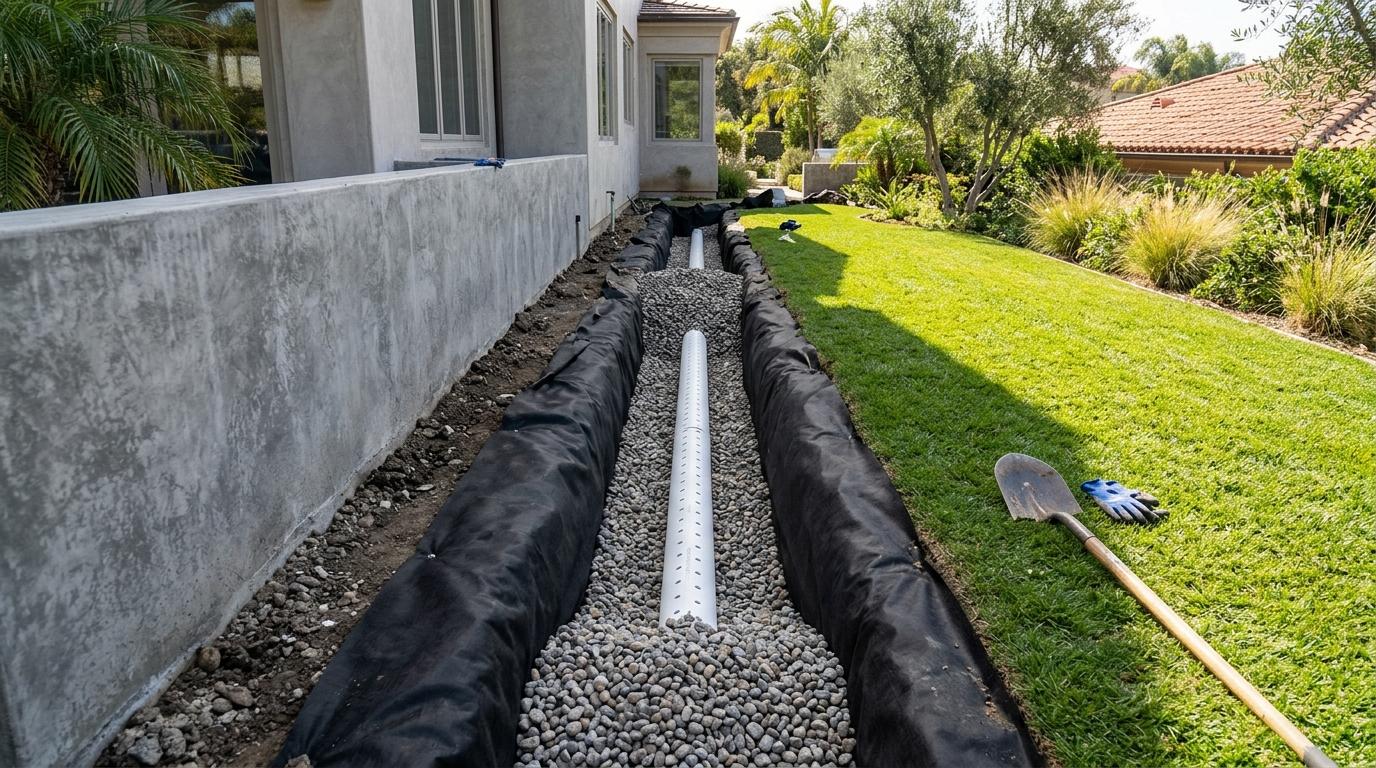
  • Classic closed turf drain: rock prism wrapped in geotextile under 6-8 inches of topsoil and sod
  • Open decorative gravel drain: exposed rock along patios, footings, and retaining walls for rapid surface intercept
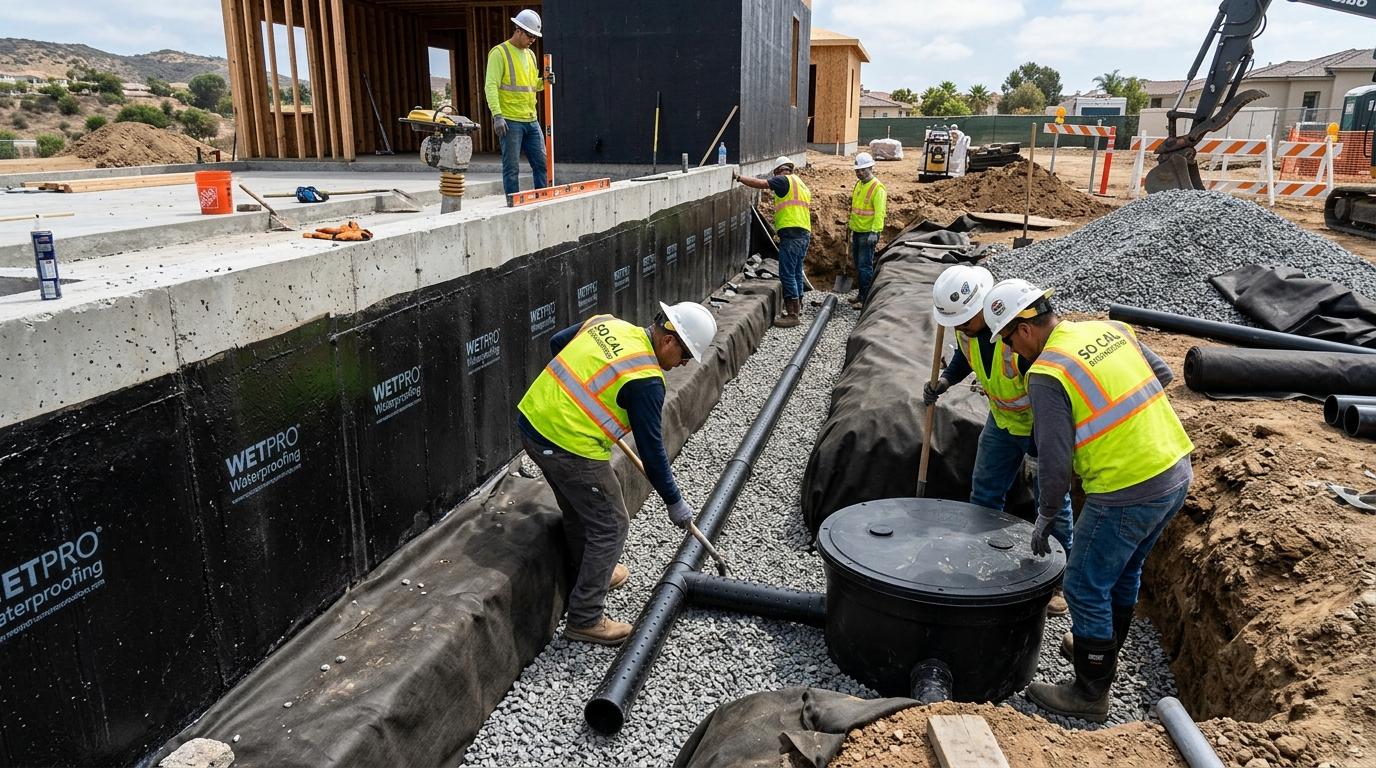
  • Double-pipe high-capacity system: dual parallel perforated pipes for extreme saturation and clay soils
  • Combo trenching: perforated groundwater line + isolated solid Schedule 40 PVC downspout line in one excavation
Alternatives

Where It Does Not Fit

Direct roof runoff into perforated pipe (dumping roof water into the trench floods the foundation) · Flat sites with no gravity outlet and no pump (creates an underground retention pond)

🌧️ Roof Runoff Alone?

Roof water is caught directly at downspouts in smooth solid pipe, not run across paving.

Explore Downspout Drains ➔
⛔ No Fall / Bowl Lot?

Gravity can't move water uphill. Sunken yards require mechanical lift evacuation.

Explore Sump Pump Stations ➔

How we build it

The order matters. Each step sets up the next one.

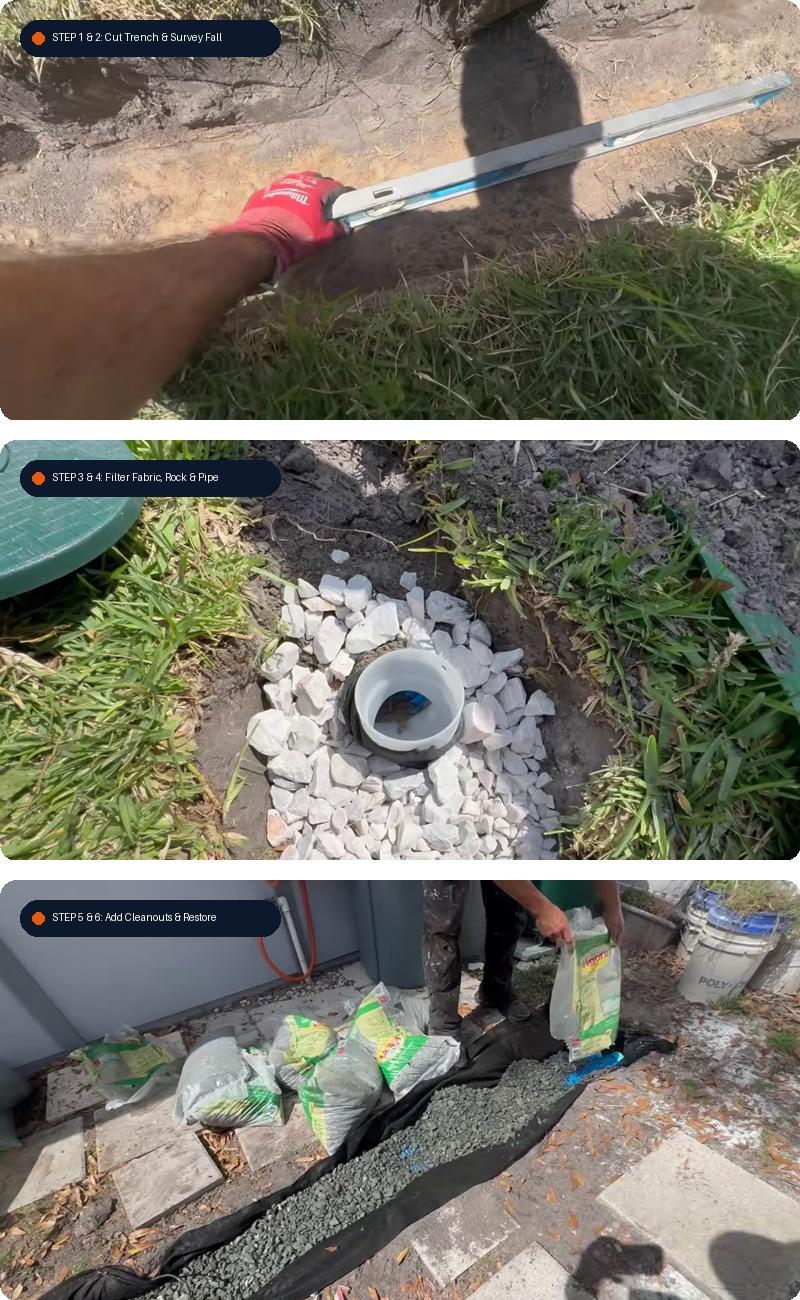
  1. Laser elevation survey & path routingWe benchmark property grades with digital rotary laser levels, establishing a guaranteed continuous fall of at least 1% (1/8" per foot) to the designated discharge point.
  2. Trench excavation & heavy geotextile barrierTrenches are excavated with landscape protection tarps and fully lined with commercial 4oz+ needle-punched geotextile to permanently block silt.
  3. Washed granite bedding & rigid perforated pipeA 4-inch base of washed 7/8" rounded granite rock cushions rigid 360° slotted pipe, integrated with accessible sweep cleanouts for lifetime maintenance.
  4. Gravel encapsulation & geotextile burrito wrapWashed rock encapsulates the pipe before the geotextile fabric is tightly overlapped 12+ inches like a burrito, permanently locking out soil and roots.
  5. Solid gravity discharge & sod restorationThe perforated line transitions to smooth solid pipe discharging to the street curb or basin, backfilled in compacted lifts with seamless sod restoration.
Three stages of a French drain: trench and fall check, filter fabric with rock and pipe, cleanouts and restoration

What goes wrong when it is done badly

No dedicated discharge point (The underground swamp)
A French drain cannot simply "dissipate" water into saturated soil. Without an outlet to the curb, swale, or sump station, it becomes an underground ditch that floods your yard.
Perforated pipe buried directly in dirt
Laying pipe without a washed gravel prism and heavy geotextile fabric causes mud and clay to blind the holes in a single season, creating a solid plug of dirt.
Dumping roof downspouts into perforated drain
Connecting roof water into a perforated line forces thousands of gallons from the gutters straight under your foundation footing instead of taking it away.
Cheap peanut-pipe foam packing ("EZ-Drain")
Styrofoam pellets in thin nylon mesh compress and collapse under heavy soil or foot traffic within 1-3 years, trapping silt with zero cleanout access.

What it costs

French drain pricing depends on linear footage, trench depth (18 inches for yard intercept to 3+ feet for foundation footing protection), granite gravel yardage, site access, tree root density, and the distance to a safe discharge outlet. An itemized estimate is provided following our on-site laser survey. The on-site inspection starts at $99 and is credited toward repair.

Questions about French drain

Can I combine roof downspouts with my French drain?

Inside the same perforated pipe: absolutely not. Roof water will leak into your foundation soil. However, we frequently run a dual-pipe combo trench: a perforated pipe in gravel at the bottom for groundwater, plus an isolated solid Schedule 40 PVC pipe on top for roof runoff, saving substantial excavation costs.

Why do you refuse to install polystyrene "peanut" pipe (EZ-Drain)?

Synthetic mesh-and-foam bundles crush under wet soil weight within 1 to 3 years, degrade under wheel traffic, and their thin fabric blinders quickly clog with silt. Our standard uses 100% natural washed granite stone and heavy non-woven geotextile built to last decades.

How do you maintain and clean a French drain over time?

We install 20-inch distribution boxes and cleanout risers at critical bends. Every few years, you simply unscrew the cap and flush the rigid line with a garden hose or pressure jetter to clear any organic fine sediment.

What if my property is completely flat with no gravity fall?

When gravity cannot achieve the mandatory 1% downward slope, we terminate the French drain into an engineered dry well infiltration cascade or a sealed submersible sump pump basin that mechanically pumps the water to the street.

How much does a French drain cost?

A French drain typically costs $25 to $38 per linear foot, depending on depth, soil, access and the discharge route. Every project is priced individually and the final cost is determined only after an on-site visit.

Which areas do you serve?

We install French drain systems in Los Angeles County and Orange County, within about 40 miles of Whittier.

Who should I call for french drain installation near Los Angeles?

Call PiersPro at (213) 583-6669. Licensed as a California General Contractor (CSLB #1110475), PiersPro designs and installs laser-graded foundation and yard French drains with washed granite rock, commercial geotextile burrito wraps, and rigid Schedule 40 PVC across Los Angeles, Pasadena, Long Beach, and Orange County.

Transparent Pricing

Start with an on-site drainage inspection

Good drainage starts with knowing which way your water moves. On every visit we shoot levels across the lot with professional equipment and map the elevations of your site. We use those numbers to design the pipe, its fall and the outlet, then price the job line by line. Led by a California Licensed General B Contractor (Lic #1110475).

  • Level shots across the lot with professional leveling equipment
  • An elevation map of your site, built for our own design calculations
  • Itemized estimate based on measured fall, not guesswork
  • The full $99 is credited toward the work if you hire us

Licensed General Contractor #1110475 (Class B, C-10). Requirements vary by city. Check your city’s building department for local rules.

ANY ON-SITE VISIT
Professional Inspection & Estimate
$99
Full site inspection, level survey and an itemized estimate for your drainage project • credited in full toward the work when you hire us
Calculate by ZIP & Book