
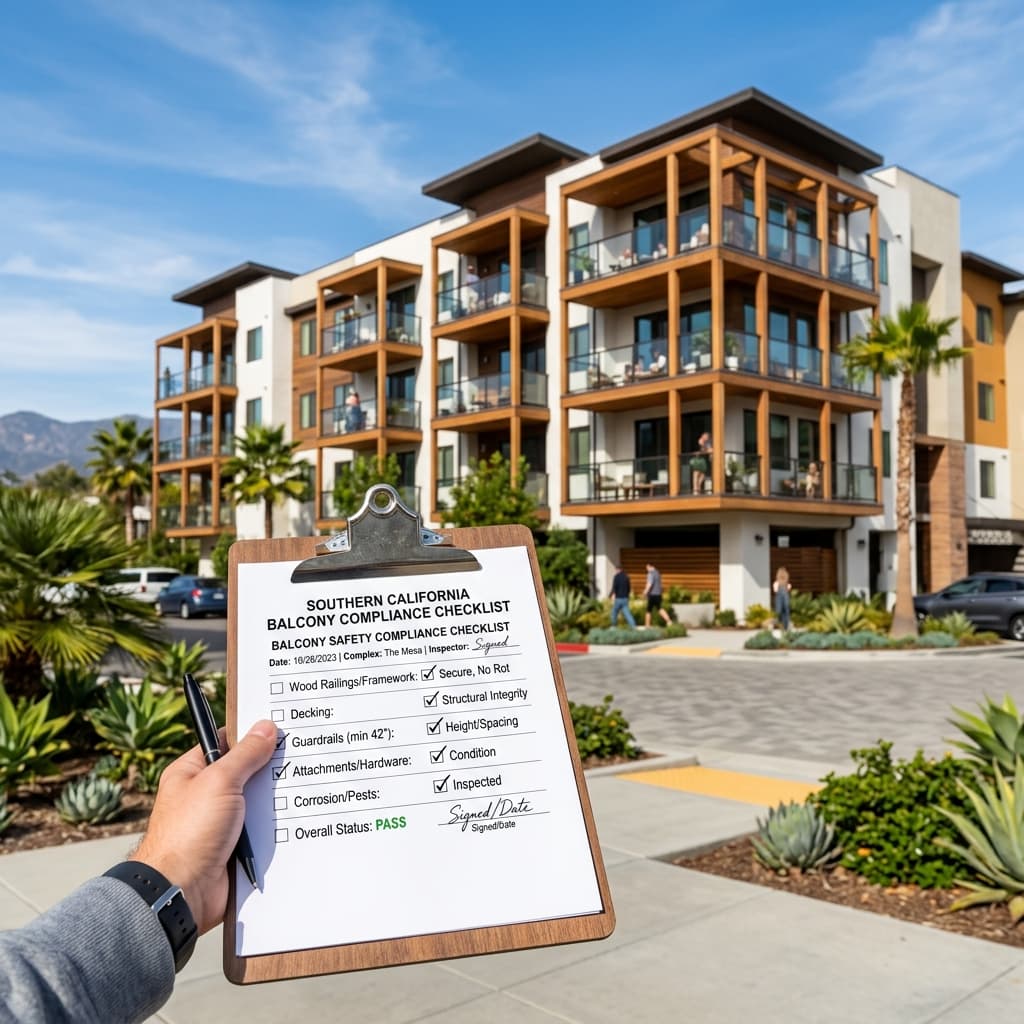
A practical guide for HOA board members and property managers to navigate balcony safety inspections. Learn about compliance timelines, scope, and engineering certifications.
Table of Contents
As a Homeowners Association (HOA) board member, managing building safety and legal compliance is a core responsibility. Under California's balcony safety laws—specifically SB-326 for condominiums and SB-721 for multi-family rental buildings—HOAs are legally required to perform periodic inspections of exterior elevated elements (EEEs).
Navigating this process requires aligning budgets, coordinate with homeowners, and hiring certified professionals. At PiersPro (CA GC License #1110475), we specialize in B2B structural inspections. This guide outlines how to prepare your HOA for compliance.
Understanding Your HOA Board Obligation
Unlike apartments, where landlords manage inspections directly, HOA boards must coordinate inspections across multiple privately owned units with common-area balconies. Under SB-326:
* Sample Size: Requires a random sample size that provides a 95% confidence level that the balconies are safe.
* Frequency: Inspections must be completed every 9 years, often aligned with reserve study cycles.
* Sign-Off: Only licensed structural/civil engineers or architects can sign off on SB-326 compliance.
Preparing Your HOA in 4 Steps
- Review Building Records: Identify which balconies, walkways, and stairs sit more than 6 feet high and rely on wood structural framing.
- Notify Homeowners: Prepare residents for inspectors accessing balconies or drilling minor borescope ventilation holes.
- Coordinate with Reserve Studies: SB-326 reports should be integrated into the association's reserve study to budget for any needed repairs.
- Hire Certified Specialists: Retain a qualified firm that provides comprehensive compliance reporting and does not inventory structural issues to sell repairs.
---
Mid-Content Call to Action
Does your HOA need a compliant balcony evaluation?
PiersPro specializes in B2B balcony evaluations for HOAs in LA and Orange Counties. We deliver detailed engineering reports, permit management, and lifetime structural repair warranties.
Request an HOA Proposal or call (213) 583-6669 to speak with our compliance team.
---
Comparison: HOA Board Compliance Options
| Compliance Aspect | Certified Architect / Engineer | Standard Handyman / Contractor |
|---|---|---|
| Legal Validity | 100% compliant with SB-326 standards | Invalid (handymen cannot sign SB-326 reports) |
| Report Details | Structural calculations, moisture maps, and stamps | Basic visual checklist |
| Liability Protection | High (transfers liability to engineering firm) | Low (board remains liable for failures) |
Frequently Asked Questions (FAQ)
Q1: What happens if our HOA missed the January 1, 2025 deadline?
A1: The association is currently out of compliance. This can lead to insurance policy non-renewals, code enforcement fines, and board member liability exposure. You should approve an inspection contract immediately to document compliance efforts.
Q2: How much does an HOA balcony inspection cost?
A2: The cost depends on the total number of units and balconies. A statistical sample (95% confidence) is calculated, and pricing typically ranges from $300 to $600 per inspected balcony.
Q3: Who pays for balcony repairs in a condo?
A3: In most condominium associations, the balcony structural framing is defined as a "common area" or "exclusive use common area," meaning the HOA is financially responsible for repairs, while the homeowner is responsible for superficial deck coverings.