
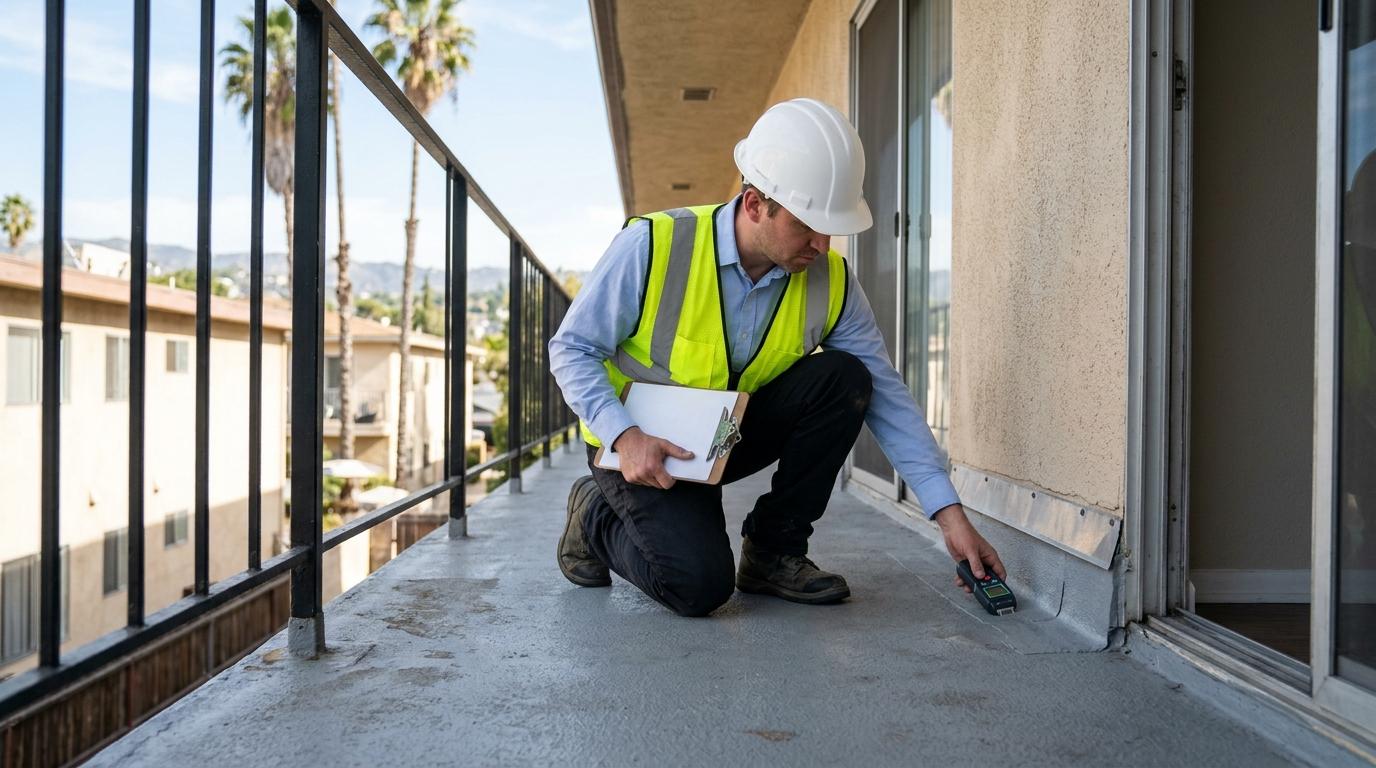
Guide to California SB 721 balcony inspections for apartment buildings in Los Angeles: what inspectors examine, how dry rot framing is repaired and how the inspection fee is credited.
Table of Contents
- California SB 721: What Apartment Owners in Los Angeles Need to Know
- What Elements Must Be Inspected?
- The Hidden Danger: Dry Rot Wood Decay & Water Ingress
- What Happens If Balcony Defects Are Found?
- Professional Waterproofing Membranes: Enduro-Kote & Pli-Dek
- PiersPro Inspection Pricing & Repair Credit
- SB 721 and SB 326 Side by Side
- Frequently Asked Questions
California SB 721: What Apartment Owners in Los Angeles Need to Know
California Senate Bill 721 (SB 721) and Senate Bill 326 (SB 326)—often collectively referred to as the California "Balcony Laws"—were enacted following tragic balcony collapses caused by hidden structural dry rot and compromised waterproofing.
SB 721 requires periodic safety inspections of Exterior Elevated Elements (EEE) in apartment buildings with three or more dwelling units. SB 326 covers condominiums and HOA communities, where the evaluation is done by a structural engineer or architect engaged by the association. PiersPro performs SB 721 inspections on privately owned apartment buildings and does repair work, not inspections, on SB 326 properties.
What Elements Must Be Inspected?
Under California Health and Safety Code Section 17973, an Exterior Elevated Element (EEE) is defined as any load-bearing structure extending beyond the exterior walls of a building that meets three criteria:
- It relies on wood or wood-based structural framing;
- Its walking surface is elevated more than 6 feet above ground level;
- It is designed for human occupancy or ingress/egress.
Inspected Structural Components:
- Cantilevered and supported balconies;
- Exterior elevated wooden walkways and breezeways;
- Stairways, stringers, landings, and handrail anchorages;
- Decks and elevated patios.
Inspectors must examine not only the visible top surface, but also the hidden load-bearing framing, waterproofing membranes, flashings, and weep systems using minimally invasive borescopes or sensor probes.
The Hidden Danger: Dry Rot Wood Decay & Water Ingress
In coastal and foothill communities like Long Beach, Santa Monica, and Pasadena, coastal fog and seasonal rain seep through microscopic fissures in outdated balcony deck coatings.
Because many older apartment buildings used standard stucco soffits under balconies without proper ventilation or scuppers, moisture becomes trapped against the wooden joists. Fungal wood decay—commonly called dry rot—silently destroys the structural integrity of the Douglas fir lumber while the top coating looks superficially sound.
What Happens If Balcony Defects Are Found?
When an inspector identifies structural rot or waterproofing failures:
- Non-Emergency Conditions: If the inspector identifies waterproofing breakdown or early wood decay that does not pose an immediate danger, the owner has 120 days to obtain permits and initiate corrective repairs.
- Emergency Hazards: If an element poses an immediate safety hazard to occupants, the inspector must notify local building officials (such as LADBS or Orange County Building Dept) within 15 days, and access to the balcony must be restricted immediately until structural shoring or repairs are executed.
Professional Waterproofing Membranes: Enduro-Kote & Pli-Dek
Once rotted structural joists and cantilevers are repaired or sistered, applying a certified Class-A fire-rated waterproofing system is essential:
- Enduro-Kote System: A multi-layered, acrylic-modified cementitious system reinforced with galvanized metal lath, waterproof acrylic basecoats, and a textured non-skid color topcoat.
- Pli-Dek Waterproofing: An ICC-ES approved fiberglass and polymer cement deck membrane designed to withstand heavy foot traffic and thermal expansion without cracking.
PiersPro Inspection Pricing & Repair Credit
At PiersPro, we offer a transparent, landlord-friendly inspection process:
- SB 721 visual and borescope inspection: price depends on the number, height and type of balconies; see the calculator on the SB-721 inspection page.
- 100% Repair Credit: If our licensed structural crews are selected to execute the required waterproofing or dry rot repairs, 100% of your initial inspection fee is credited directly toward the project total.
SB 721 and SB 326 Side by Side
| SB 721 | SB 326 | |
|---|---|---|
| Applies to | Apartment buildings with 3 or more units | Condominiums and HOA communities |
| Who inspects | Architect, engineer, qualified contractor or certified building inspector | Structural engineer or architect engaged by the association |
| PiersPro role | Inspection on privately owned buildings, and repair | Repair only |
Protect your tenants, maintain your property insurance, and secure full city compliance. Call PiersPro at (213) 583-6669 or book your inspection online.
Frequently Asked Questions
Q1: Does PiersPro inspect HOA and condominium balconies?
A1: No. Under SB 326 the association engages a structural engineer or architect. PiersPro carries out the repair work identified in that evaluation.
Q2: How much of the building is inspected under SB 721?
A2: A sample of at least 15% of each type of exterior elevated element. More may be opened if the sample shows damage.
Q3: Is the inspection fee credited toward repair?
A3: Yes. If PiersPro is hired for the repair or waterproofing work, the inspection fee is credited toward the project.
Prices and ranges in this article are approximate and for planning only, and every project is priced individually. The final cost is determined only after an on-site estimate and may differ from the figures shown on this site.
Permit rules, fees, codes and deadlines vary by city and county and change over time. Please confirm the details with the building department of your city or county before starting work.
For SB 326 requirements, please check the website of your city for details.
About the author: This article was prepared by the PiersPro team. PiersPro is a d/b/a of SKILL SEE SERVICES INC, a California licensed contractor (Class B, CSLB #1110475). Verify the license on the CSLB website.