
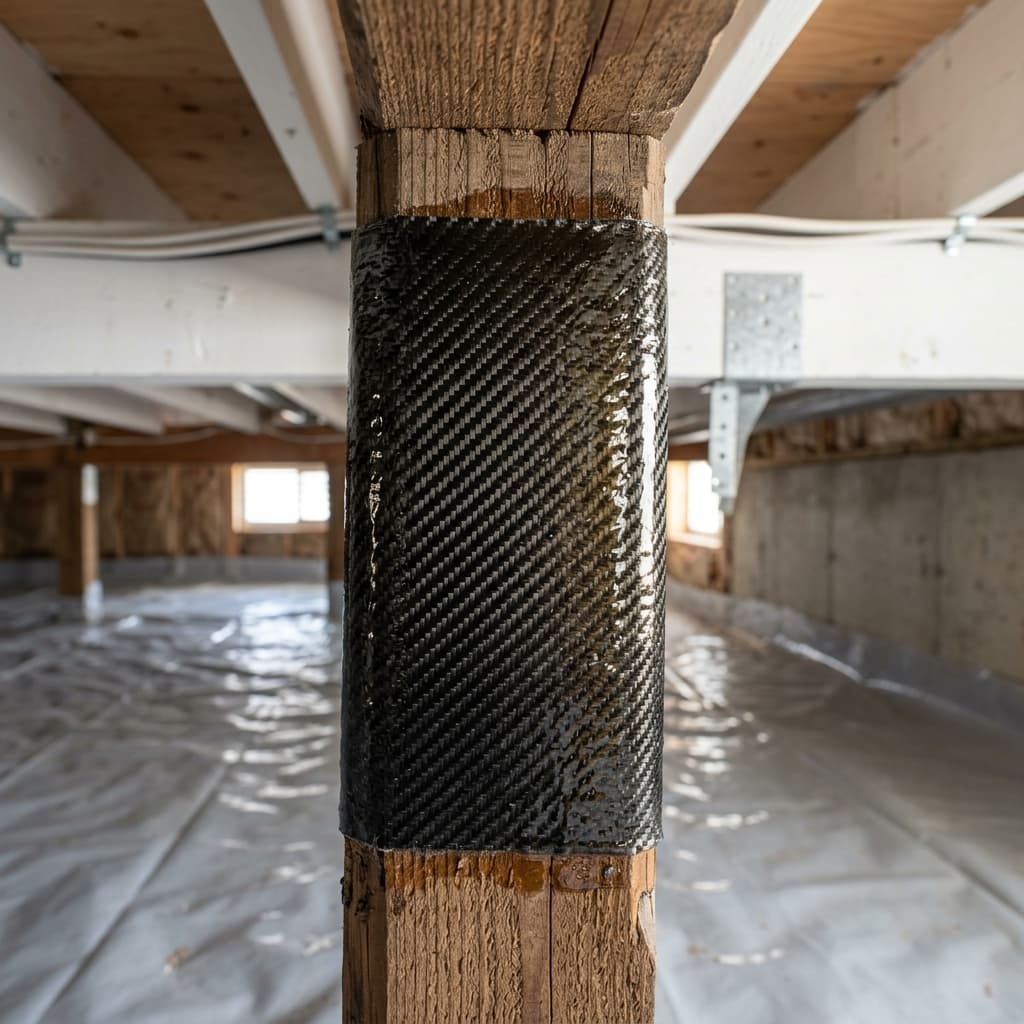
Discover how carbon fiber structural wraps reinforce load-bearing wood beams. Learn how this modern technology avoids expensive timber replacement and cures in hours.
Table of Contents
When primary load-bearing wood beams (girders or columns) in a crawl space suffer localized dry rot or structural cracking, homeowners often assume that replacing the entire timber is the only solution. However, beam replacement is highly invasive, requiring heavy shoring, lifting the floors above, and temporary evacuation.
A modern alternative is carbon fiber structural reinforcement.
At PiersPro (CA GC License #1110475), we utilize carbon fiber composites to reinforce and repair structural wood members non-destructively. In this guide, we explain how carbon fiber wraps work, compare them to traditional sistering, and discuss the engineering specifications.
What is Carbon Fiber Structural Reinforcement?
Carbon fiber reinforcement involves wrapping or bonding high-strength carbon fiber fabrics (CFRP) to weakened wood beams using structural epoxy resins.
- The Material: Carbon fiber has very high tensile strength for its weight while adding almost no weight or thickness to the timber.
- The Bonding: The structural epoxy consolidates the dry wood fibers and creates a molecular bond between the carbon fiber wrap and the wood beam.
- The Load Path: Once cured, the carbon fiber wrap absorbs the bending and tension stresses of the beam, restoring its load-bearing capacity.
Why Choose Carbon Fiber Over Replacement?
- No Demolition: We do not need to slide long wood beams into tight crawl spaces or cut plumbing lines.
- Low Clearance Friendly: Carbon fiber wraps are ideal for crawl spaces with less than 18 inches of clearance.
- Fast Curing: The structural epoxy cures in 24 hours, restoring full load-bearing capacity immediately.
Do you have a cracked or decaying load-bearing beam?
PiersPro offers a detailed on-site inspection from $99 featuring Resistograph wood scanning. We design customized carbon fiber repair plans that save time and money.
Schedule a Structural Evaluation or call (213) 583-6669 to speak with our engineering team.
Carbon Fiber, Sistering or Replacement
| Carbon fiber wrap | Sistering | Full replacement | |
|---|---|---|---|
| Best for | Cracked or locally weakened member, tight access | Decay or cracks along part of a member | Member decayed through or crushed |
| Shoring needed | Little | Some | Full |
| Access needed | Minimal | Room to slide in new lumber | Room to remove and install |
| Works on wet or actively decaying wood | No | After moisture is fixed | Yes, after moisture is fixed |
Where It Does Not Fit
- Active decay. Fabric bonded over wet, decaying wood traps moisture. The source is corrected and the wood dried first.
- Crushed bearing ends. Where a beam has crushed at its support, the bearing is rebuilt.
- Members that are simply undersized. A beam that was never big enough needs added support or a larger member.
How the Decision Is Made
The member is probed and measured, the moisture content is checked, and the cause of the damage is identified. Where the repair carries structural load, the layout follows an engineer's design and the product manufacturer's instructions.
Frequently Asked Questions (FAQ)
Q1: Is carbon fiber repair approved by building codes?
A1: Yes. Carbon fiber structural wraps (CFRP) are fully approved for structural concrete and wood repairs under ICC-ES evaluation standards.
Q2: How much does carbon fiber beam reinforcement cost?
A2: While the material itself is high-tech, the labor savings from avoiding shoring, lifting, and demolition make carbon fiber reinforcement 30% to 50% cheaper than full girder replacement, with average project costs ranging from $2,500 to $4,500.
Q3: Can carbon fiber be used on any damaged beam?
A3: No. It suits members that are cracked or locally weakened but dry and otherwise sound. Wood that is decayed through, crushed or still wet needs sistering or replacement.
Q4: Does carbon fiber stop dry rot?
A4: No. Decay stops when the moisture source is removed. Reinforcement is applied only after the wood is dry and the decayed portion has been dealt with.
Prices and ranges in this article are approximate and for planning only, and every project is priced individually. The final cost is determined only after an on-site estimate and may differ from the figures shown on this site.
Permit rules, fees, codes and deadlines vary by city and county and change over time. Please confirm the details with the building department of your city or county before starting work.
About the author: This article was prepared by the PiersPro team. PiersPro is a d/b/a of SKILL SEE SERVICES INC, a California licensed contractor (Class B, CSLB #1110475). Verify the license on the CSLB website.