
How helical piers stabilize hillside foundations in La Habra Heights: how they work, when they fit, what the install looks like and what drives the cost.
Table of Contents
Helical piers in La Habra Heights solve the most common hillside problem: a house that settles on its downhill side. A house on a slope rarely settles evenly. The downhill side drops, the uphill side stays, and the cracks follow. In La Habra Heights, where lots sit on the Puente Hills formation of clay and shale, the usual fix is to carry the foundation past the weak upper soil to ground that does not move. Helical piers do that with small equipment and almost no excavation, which matters on a steep lot with a narrow driveway.
How a helical pier works
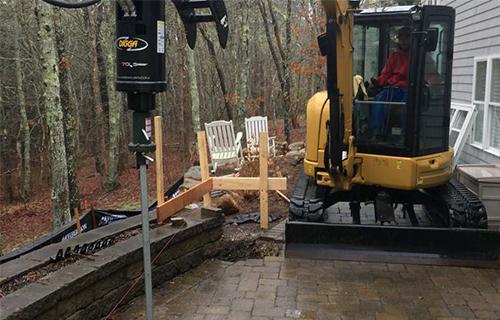
A helical pier is a high-strength steel shaft with one or more screw-shaped plates welded near the tip. A hydraulic motor turns it into the ground like a large screw. Extensions are added until the plates reach soil strong enough to carry the load. A heavy-duty steel bracket then ties the top of the pier to the foundation footing.
The installer monitors hydraulic torque continuously. The harder the pier is to turn, the more load the soil at that depth can carry, so each pier is verified as it goes in instead of assumed. The mechanics are covered in how helical piers work.
Why it fits a hillside lot
- Small equipment: the drive motor mounts on a mini excavator or a handheld frame, so it reaches narrow side yards and terraced lots.
- Minimal excavation: only a pocket at each pier location is dug. There are no large holes and almost no soil to haul down a steep driveway.
- No cure time: a pier carries load as soon as it is installed and bracketed.
- Depth on demand: if load-bearing soil is deeper than expected, another extension is added on site.
Helical piers compared with other hillside options
| Helical piers | Concrete piers or caissons | Drainage correction only | |
|---|---|---|---|
| What it does | Transfers load to deeper, firm soil | Transfers load to deeper soil or rock | Removes the water that causes movement |
| Equipment | Mini excavator or handheld drive | Drill rig, concrete delivery | Trenching tools |
| Excavation | Small pocket per pier | Large holes, spoil to haul | Trenches |
| Load after install | Immediate | After concrete cures | Not a structural support |
| When it fits | Settled footing, tight access | Heavy loads, engineer's design | Movement is small and water-driven |
Drainage is not an alternative to piers so much as a companion. If water caused the settlement, it has to be corrected or the problem returns somewhere else.
When helical piers are the right call
- The downhill corner or wall of the house has settled.
- A room addition, deck or retaining wall needs a foundation on sloped or filled ground.
- A new structure is planned where the upper soil layer is expansive or unconsolidated.
What they do not fix
Piers support a structure. They do not stop a hillside that is sliding as a whole. If the hillside itself shows global slope movement, a geotechnical engineer has to evaluate it first. Dense rock or large cobbles can also stop a pier short of design depth, which changes the engineering plan.
On La Habra Heights lots two related items are usually checked at the same visit: retaining walls that lean or crack, and slope drainage that sends water toward the footing. Both affect how long a foundation repair holds.
What the job looks like
- Inspection and floor elevation survey to locate the settlement.
- Engineered pier layout and a building permit.
- Excavation at each pier location along the footing.
- Installation to the required torque, with readings logged.
- Brackets set, then the foundation is stabilized or lifted.
- Backfill and site cleanup.
What drives the cost
Number of piers, depth to load-bearing soil, equipment access, and engineering and permit fees. Helical piers typically run $1,800 to $2,500 per pier installed. A hillside home that needs 6 to 10 piers lands between about $11,000 and $25,000. Our article on how many helical piers a house needs explains how the count is worked out.
Downhill side dropping? Book a foundation inspection and get a measured pier layout and a written estimate.
Frequently Asked Questions
Q1: How deep do helical piers go on a hillside lot?
A1: As deep as needed to reach soil that produces the required installation torque. The depth is not guessed in advance: extensions are added on site until each pier reaches its target reading.
Q2: Will piers lift the house back to level?
A2: Sometimes. Piers always stabilize the footing. Whether the house can also be lifted depends on the structure, the amount of settlement and the risk of damage to finishes, and it is decided after the elevation survey.
Q3: Can helical piers be installed in a narrow side yard?
A3: Usually yes. The drive motor fits on a mini excavator or a handheld frame, and only a small pocket is dug at each pier, which is why the method suits terraced and tight-access lots.
Q4: Do helical piers stop a slope from moving?
A4: No. They support the building. If the whole hillside is moving, a geotechnical engineer must evaluate the slope before any foundation work is designed.
Prices and ranges in this article are approximate and for planning only, and every project is priced individually. The final cost is determined only after an on-site estimate and may differ from the figures shown on this site.
Permit rules, fees, codes and deadlines vary by city and county and change over time. Please confirm the details with the building department of your city or county before starting work.
About the author: This article was prepared by the PiersPro team. PiersPro is a d/b/a of SKILL SEE SERVICES INC, a California licensed contractor (Class B, CSLB #1110475). Verify the license on the CSLB website.