
Complete California guide to mobile home auger anchors, double-helix shafts, HUD 3,150/4,725 lb load ratings, soil torque testing, stabilizer plates, and HCD Title 25 rules.
Table of Contents
- Anatomy of a Mobile Home Ground Anchor Kit
- Federal HUD Load Ratings: The 3,150 lb / 4,725 lb Rule
- Soil Classification & The Torque Probe Method
- Critical Installation Rules That Pass (or Fail) Inspection
- When Auger Anchors Won't Go In: Concrete Deadman Anchors
- California HCD Title 25: Tie-Downs vs. Earthquake Bracing (ERBS)
- Why Start With an Instrumental Inspection?
- Frequently Asked Questions
A manufactured or mobile home is only as secure as the steel connecting its chassis to the ground. Across Southern California—from high-wind Santa Ana corridors in Chino Hills and the Inland Empire to coastal parks in Orange County and hillside communities near Whittier and Pasadena—properly sized and installed mobile home ground anchors and tie-down straps are what keep a home from shifting off its piers during severe wind gusts or seismic shaking.
Yet most homeowners never see what is actually holding their home down until an HCD inspector, escrow lender, or insurance carrier flags missing or corroded tie-downs. Below is a practical, code-backed breakdown of how mobile home ground anchors work, what federal HUD (24 CFR Part 3285) and California HCD (Title 25) standards actually require, and how to tell when your anchoring system needs professional attention.
Anatomy of a Mobile Home Ground Anchor Kit
A compliant tie-down point is not a single piece of hardware—it is an engineered assembly where every component must match the same load rating:
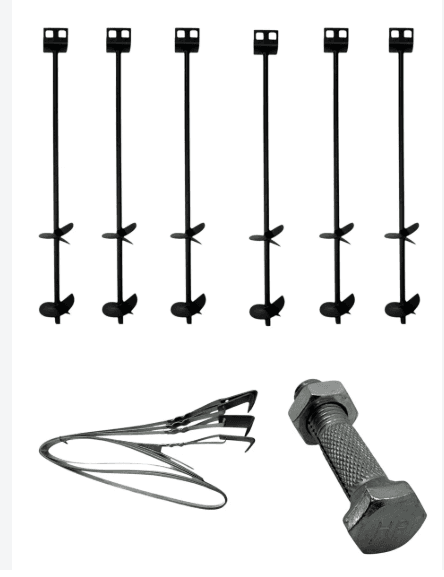
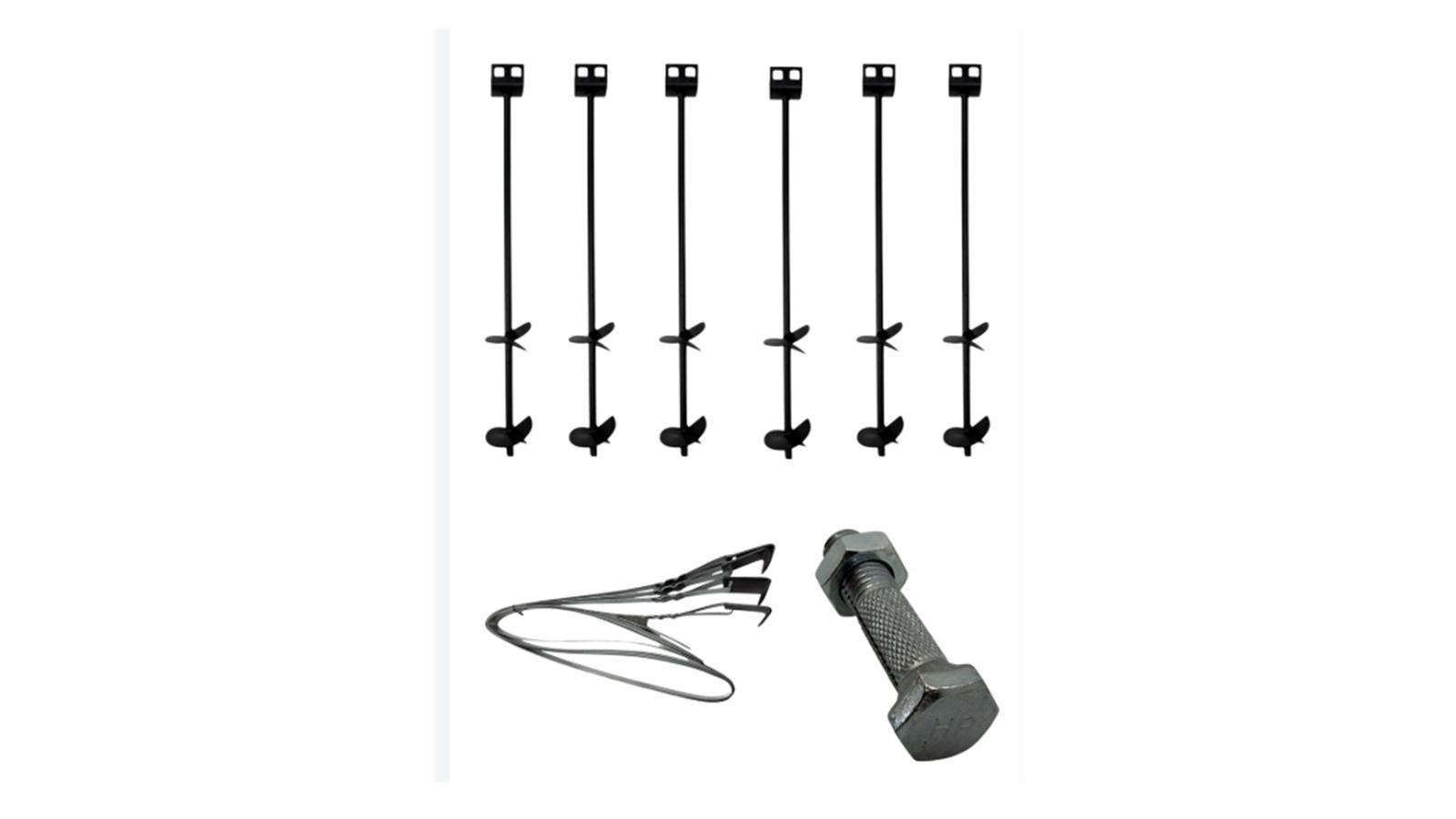
- Helical (Auger) Ground Anchor Shaft: A heavy forged steel rod (typically 30", 36", or 48"+ long) fitted with one or two steel auger blades (single-helix or double-helix, commonly 4" and 6" diameters). Double-helix anchors engage deeper soil layers and deliver far higher pullout resistance in softer or disturbed soils.
- Slotted Anchor Head: Welded to the top of the shaft (often a double-head square housing that accepts two independent tensioning bolts when both a frame tie and a diagonal or vertical tie converge at the same point).
- Knurled Slotted Tensioning Bolt & Hex Nut: Fits inside the anchor head. The galvanized steel strap threads through the center slot and winds around the knurled shaft as the bolt is tightened with a wrench.
- Galvanized Steel Tie-Down Strapping & Frame Clamps: Flat high-tensile steel strapping conforming to ASTM D3953 (typically 1-1/4" wide × 0.035" thick, zinc-coated for corrosion resistance), anchored to the mobile home's steel I-beam using certified steel frame clamps or buckles.
- Stabilizer Plate: A heavy steel plate driven vertically into the soil right beside the top of the anchor shaft (required by 24 CFR § 3285.403 and most anchor listings) to stop the anchor head from slicing laterally through the soil when the diagonal strap pulls sideways.
Federal HUD Load Ratings: The 3,150 lb / 4,725 lb Rule
Under federal Model Manufactured Home Installation Standards (24 CFR § 3285.402), every certified ground anchor assembly—including the anchor, stabilizer plate, tensioning bolt, strapping, and frame clamp—must pass two strict load benchmarks in the weakest soil class for which it is listed:
- Minimum Working Load: 3,150 lbs — the sustained load the anchor assembly must hold without exceeding allowable displacement (typically no more than 2 inches of vertical pullout or 3 inches of horizontal movement).
- Minimum Ultimate Load: 4,725 lbs — the failure-test threshold incorporating a mandatory 1.5× safety factor (3,150 × 1.5 = 4,725 lbs) without shaft, weld, bolt, or strap breakage.
Hardware store cable, uncertified turnbuckles, or generic fence augers cannot meet these ratings and will automatically fail California HCD or lender inspections.
Soil Classification & The Torque Probe Method
The exact same 36-inch double-helix anchor holds dramatically differently in dense foothill clay than it does in loose sandy fill. That is why 24 CFR § 3285.402 (Appendix) requires matching anchor selection to actual on-site soil resistance—measured with a 5-foot steel soil test torque probe and torque wrench:
| HUD Soil Class | Soil Description | Torque Probe Reading | What It Means for Anchoring |
|---|---|---|---|
| Class 2 | Dense / firm clay, compact gravel, dense sand | ≥ 551 in-lbs | Standard listed auger anchors achieve full rating at shorter depths |
| Class 3 | Medium-dense clay, firm silt, medium sand | 351 – 550 in-lbs | Requires Class 3-listed single or double-helix anchors + stabilizer plates |
| Class 4A | Firm-to-loose sandy clay, silty sand | 276 – 350 in-lbs | Requires deeper double-helix anchors certified specifically for Class 4A |
| Class 4B | Loose sand, soft clay, uncompacted fill | 175 – 275 in-lbs | Requires specialized Class 4B deep dual-helix anchors and heavy stabilizer plates |
| Below Class 4B | Very soft clay, peat, saturated fill | < 175 in-lbs | Standard auger anchors prohibited — requires licensed PE structural engineering |
Important California note: Southern California parks frequently sit on expansive clay soils that feel rock-hard in August and turn soft after a week of winter rain. Always evaluate soil class conservatively and keep yard drainage directed away from the under-home pad so runoff does not wash out anchor resistance.
Critical Installation Rules That Pass (or Fail) Inspection
Even certified hardware fails if installed incorrectly. Here are the five field details inspectors check first:
- Full anchor depth: The anchor head must be driven down until the bottom of the slotted head sits close to grade (typically within 1–2 inches of the soil surface), never left sticking a foot out of the ground where bending leverage multiplies.
- Stabilizer plates installed flush: Under 24 CFR § 3285.403, stabilizer plates must be driven vertically to their full depth directly against the tension side of the anchor shaft. Missing stabilizer plates are one of the #1 causes of tie-down failure.
- Proper strap angle (30° to 60°): Diagonal frame tie-down straps should run from the mobile home's steel I-beam to the anchor head at an angle between 30° and 60° from horizontal (with ~45° being the sweet spot for balanced uplift and lateral resistance).
- Minimum wraps on the slotted bolt: Thread the galvanized strap through the knurled slotted bolt and wind 4 to 5 full tight wraps—enough friction to prevent slippage under load without over-filling the housing.
- Never anchor an unlevel frame: Tensioning tie-down straps onto a settled or twisted chassis locks structural distortion into the home. Always check for signs your mobile home needs releveling and complete mobile home leveling and pier stabilization before final strap tensioning.
When Auger Anchors Won't Go In: Concrete Deadman Anchors
What happens when your installer tries to drive a double-helix anchor and hits solid caliche, buried river cobbles, tree roots, or an existing concrete pad at 12 inches? You cannot cut off the shaft or leave an auger half-buried.
In rocky soil or over an existing concrete slab, the compliant solution is a concrete deadman anchor (a buried reinforced concrete block with an embedded galvanized eye-ring) or an engineered slab anchor. Read our full technical breakdown in Concrete Deadman Anchors for Mobile Homes in California: How They Work & HCD Requirements.
California HCD Title 25: Tie-Downs vs. Earthquake Bracing (ERBS)
Homeowners in Los Angeles, Cerritos, Glendale, and Orange County often confuse wind tie-downs with seismic bracing. Under California Code of Regulations (CCR) Title 25, Chapter 2:
- Ground anchors & tie-down straps are primarily designed and tested for wind uplift and lateral wind resistance (required across Wind Zones I, II, and III, and whenever specified by the home's installation manual or local wind load map).
- Earthquake-Resistant Bracing Systems (ERBS)—governed by Title 25, Chapter 2, Article 7.5 and permitted via HCD Form 50 ERBS—are engineered specifically to prevent a mobile home from falling off its steel piers during California seismic shaking.
If you are upgrading an older manufactured home for safety, insurance, or resale, combining properly tensioned ground anchors with an HCD-certified ERBS provides complete wind and seismic protection. Learn how California's grant and compliance rules work in our California EMR & ERBS Mobile Home Seismic Retrofit Guide.
Why Start With an Instrumental Inspection?
Because only a few inches of a ground anchor are visible above the soil, a quick glance under the skirting cannot tell you whether your existing anchors are rusted through underground, missing stabilizer plates, pulling out of loose soil, or attached to an unlevel frame.
At PiersPro (California Class B Contractor, CSLB #1110475), we offer instrumental [structural foundation inspections](/services/structural-foundation-inspection) starting at $250—with 100% of the fee credited toward repair if you hire us. We map floor elevations to 1/10th of an inch, inspect every pier, strap, anchor head, and drainage line under your home, and deliver an itemized written plan—whether you need mobile home leveling, new HUD/HCD-compliant ground anchors, helical piers, earthquake retrofitting, foundation bolting, or full foundation repair. See our Los Angeles foundation inspection cost guide for full tier details.
Need compliant mobile home ground anchors, tie-downs, or a pre-escrow under-home inspection in Southern California? Book your instrumental inspection today.
Frequently Asked Questions
Q1: How many ground anchors does a mobile home need?
A1: Anchor count and spacing depend on the home's length, width (single-wide vs. double-wide), roof pitch, local Wind Zone, and on-site soil class. In standard Wind Zone I installations, frame ties are typically spaced every 8 to 12 feet along each exterior I-beam (plus longitudinal/end-wall ties), following the manufacturer's installation manual or 24 CFR § 3285.402 tables.
Q2: Are double-helix ground anchors better than single-helix anchors?
A2: In medium-to-loose soils (Class 3, 4A, and 4B), yes. Double-helix anchors engage two separate soil strata along the shaft, dramatically increasing uplift resistance and reducing the risk of gradual pullout compared to single-helix anchors.
Q3: Do mobile home ground anchors require stabilizer plates in California?
A3: In nearly all soil classes and modern anchor listings, yes. Under 24 CFR § 3285.403, if the anchor's certification or manufacturer instructions specify a stabilizer plate, it must be driven vertically to full depth beside the anchor shaft to prevent lateral head rotation under wind load.
Q4: Can corroded or loose tie-down straps be retensioned, or should they be replaced?
A4: If the galvanized strap and slotted bolt are sound and free of rust pitting, a technician can check the piers, relevel if needed, and retension the strap cleanly. If the strap shows heavy rust, kinks, or frayed edges—or if the anchor head has pulled sideways through the soil—the assembly should be replaced with new ASTM D3953 strapping and properly rated anchors.
Prices and ranges in this article are approximate and for planning only, and every project is priced individually. The final cost is determined only after an on-site estimate and may differ from the figures shown on this site.
Permit rules, fees, codes and deadlines vary by city and county and change over time. Please confirm the details with California HCD or the building department of your city or county before starting work.
About the author: This article was prepared by the PiersPro team. PiersPro is a d/b/a of SKILL SEE SERVICES INC, a California licensed contractor (Class B, CSLB #1110475). Verify the license on the CSLB website.