
When screw-in augers hit rock, caliche, or concrete slabs, concrete deadman anchors secure California mobile homes to HUD 4,725 lb standards. Learn sizing, installation, and HCD rules.
Table of Contents
- What Is a Concrete Deadman Anchor and How Does It Work?
- Construction, Typical Dimensions, and HUD Load Ratings
- When a Concrete Deadman Anchor Is Necessary
- Practical Field Methods: Cast-in-Place vs. Precast Deadman Blocks
- California HCD Inspection & Code Requirements
- Don't Anchor an Unlevel Frame: Inspect First
- Frequently Asked Questions
If you own a manufactured or mobile home in Southern California—whether in a hillside park near Whittier and Chino Hills, an older community in Cerritos, or a coastal lot in Orange County—standard screw-in auger tie-down anchors do not always go into the ground. Ten inches down, the auger hits solid caliche, buried river cobbles, tree roots, or an old concrete slab and stops dead.
When a screw-in ground anchor cannot reach required depth or torque, California contractors turn to a proven heavy-duty alternative: the concrete deadman anchor.
What Is a Concrete Deadman Anchor and How Does It Work?
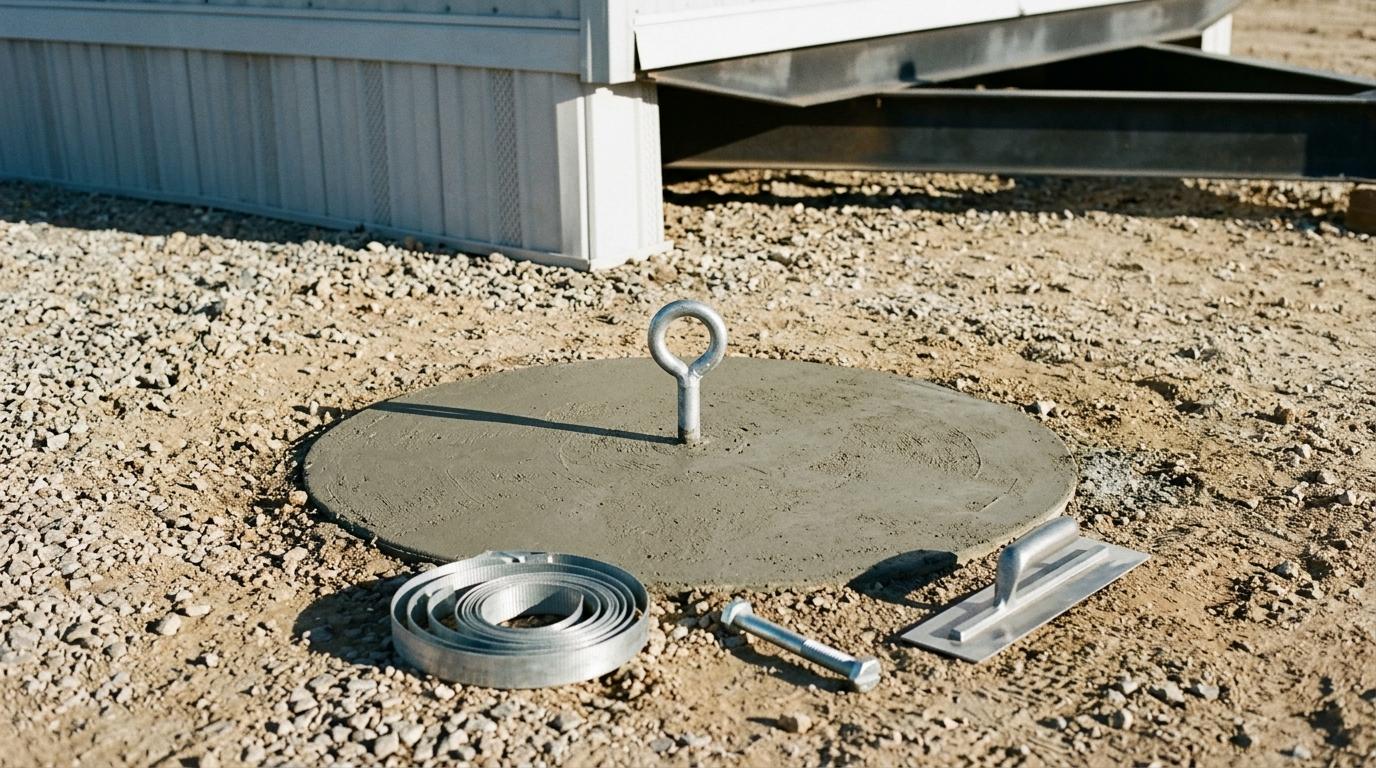
A deadman (or buried concrete mass anchor) is a reinforced underground concrete block cast with an embedded galvanized or stainless steel anchor rod and eye-ring. It replaces a standard helical auger anchor wherever soil or site obstructions prevent screwing an anchor to full depth.
The holding mechanics are completely different from a standard screw-in anchor:
- How a standard auger anchor holds: A steel helix blade screwed 36 to 48 inches deep resists pullout by engaging an inverted cone of undisturbed soil above the blade.
- How a concrete deadman holds: A deadman resists uplift and lateral earthquake or wind loads through its own concrete dead weight combined with the passive resistance of the compacted soil layer buried on top of it.
Because the anchor relies on mass and overburden weight, proper depth and layered backfill compaction are just as critical as the concrete pour itself.
Construction, Typical Dimensions, and HUD Load Ratings
A field-built or engineered concrete deadman is not just a random bucket of concrete dumped in a shallow hole. To meet HUD federal manufactured housing pullout standards (3,150 lbs working load / 4,725 lbs ultimate pullout capacity per tie-down point), the assembly is built to strict structural geometry:
- Excavation depth: Dug below loose topsoil and organic fill—typically 24" to 36"+ deep, depending on soil classification, manufacturer listing, or site-specific engineering calculations.
- Reinforcement & embedded hardware: A bent steel rebar cage paired with a heavy-duty galvanized or stainless steel anchor rod with a welded or forged eye-ring (or a factory-engineered precast concrete anchor block with an integrated tie-down eye).
- Typical monolithic dimensions: Depending on soil bearing capacity and load requirements, blocks commonly start around 12" × 12" × 24" or 18" × 18" × 24"—and larger where sandy or loose soils demand extra mass.
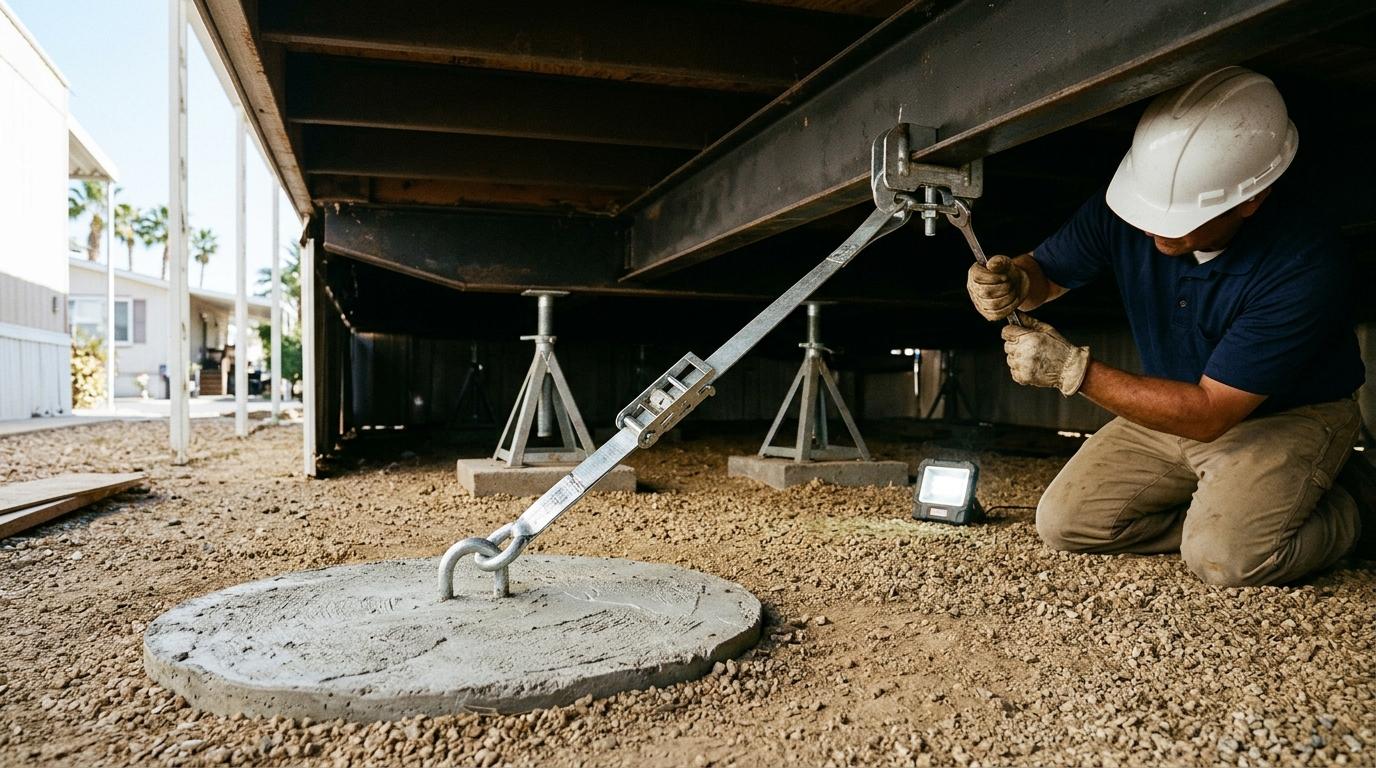
- Tie-down strap connection: A standard galvanized steel tie-down strap runs from the mobile home's steel I-beam chassis down to the deadman's eye-ring at a 30° to 60° angle, tensioned with a slotted bolt head exactly like a standard auger anchor.
When a Concrete Deadman Anchor Is Necessary
In Los Angeles County, the San Gabriel Valley, and Orange County, we routinely specify deadman anchors in three recurring site conditions:
1. Caliche, Bedrock, and Rocky Alluvial Soil
Foothill and canyon parks near Pasadena, Azusa, Sylmar, and the Inland Empire frequently sit over dense alluvial cobbles or cemented caliche. A screw-in auger hits refusal at 10–15 inches and spins in place. Excavating a localized pit and pouring a deadman solves the refusal without compromising pullout resistance.
2. Mobile Homes Installed Over an Existing Concrete Slab
Many older California mobile home spaces sit on legacy concrete pads. You cannot screw a standard auger through concrete. There are two compliant paths:
- Cut a pocket through the slab, excavate beneath it, pour a recessed concrete deadman, and patch the surface cleanly; or
- Install certified mechanical expansion or chemical epoxy slab anchors—only when core verification or plans confirm the existing slab has engineered thickness and steel reinforcement capable of carrying the full 4,725 lb ultimate uplift load.
3. Coastal and Corrosive Soils
Near the coast—or in parks with high water tables and poor yard drainage—thin steel auger discs corrode rapidly underground. A concrete deadman built with a hot-dip galvanized or stainless steel embedded eye-rod offers dramatically longer service life in aggressive soils.
Practical Field Methods: Cast-in-Place vs. Precast Deadman Blocks
Digging a wide open trench under a low-clearance mobile home by hand is slow and destructive. Experienced crews use two much cleaner installation methods depending on headroom and access:
| Method | How It Is Built | Best Used When | Key Watch-Out |
|---|---|---|---|
| Auger-Drilled Cast-in-Place Deadman | Drill a 12"–16" diameter vertical shaft 30"–36" deep, set bent rebar + galvanized eye-rod, pour concrete flush with design depth | Open perimeter access or enough room for a compact handheld/towable earth auger | Must cure to full strength before tensioning tie-down straps |
| Precast Deadman Block | Factory-cast concrete anchor block (100 to 250+ lbs) with integral steel eye lowered into a hand-dug pit | Tight under-home clearance where a concrete mixer or chute cannot reach | Heavy to maneuver under skirting; requires layered soil compaction during backfill |
| Slab Pocket / Engineered Slab Anchor | Saw-cut window through existing concrete pad to pour deadman below, or install listed slab anchors | Home sits on an existing concrete pad | Unreinforced 3.5" patio slabs cannot hold standard expansion anchors |
For most perimeter installations, the 12"–16" augered cast-in-place deadman is the cleanest, fastest solution—essentially creating a mini cast-in-place pier anchor without tearing up landscaping or hand-digging a massive pit.
California HCD Inspection & Code Requirements
This is where many DIY installs and unpermitted park handymen fail inspection. Under California Department of Housing and Community Development (HCD) regulations (Title 25):
- Standard screw-in auger anchors can generally be installed directly from an HCD-listed manufacturer's soil-test chart ("out of the box").
- Concrete deadman anchors must either match an HCD-approved anchor system listing and manufacturer installation table, or be backed by a California-licensed structural engineer's (PE) site-specific calculations and drawings.
That compliance distinction matters tremendously if you are:
- Installing or upgrading an Earthquake Resistant Bracing System (ERBS)—see our California EMR & ERBS Mobile Home Seismic Retrofit Guide,
- Converting a manufactured home to real property (HCD Form 433A permanent foundation certification),
- Selling or refinancing a home where escrow or an insurer flags missing tie-downs or unlevel piers.
Don't Anchor an Unlevel Frame: Inspect First
Tightening tie-down straps onto a twisted or settled steel I-beam locks the distortion in place and makes sticking doors, cracked drywall, and sloped floors worse. Before installing deadman anchors or seismic bracing, always verify pier alignment, floor elevations, and soil drainage.
Check our guide to 5 signs your mobile home needs releveling, or pair your tie-down upgrade with professional mobile home leveling and pier stabilization. If your park sits on moisture-sensitive ground, it also helps to understand how expansive clay soils shift concrete pier pads over wet and dry California seasons.
At PiersPro, we handle the entire scope under one California Class B license—from structural foundation inspections and elevation surveys (starting at $250, 100% credited toward repair) to foundation repair, helical piers, earthquake retrofitting, foundation bolting, and HCD-compliant mobile home releveling and anchoring. See what goes into pricing in our Los Angeles foundation inspection cost guide.
Need HCD-compliant tie-downs, concrete deadman anchors, or a full mobile home releveling inspection in Southern California? Book your instrumental inspection today and get clear measurements and an itemized written scope before any work begins.
Frequently Asked Questions
Q1: Can a concrete deadman anchor pass a California HCD inspection?
A1: Yes—provided it is installed strictly per an HCD-approved anchor manufacturer's listing/chart or per stamped drawings from a California-licensed structural engineer. Unlisted "homemade" concrete blocks poured without engineering documentation will typically fail HCD inspection.
Q2: How much pullout force must a mobile home deadman anchor resist?
A2: Under federal HUD manufactured home standards, each tie-down anchor point must resist a minimum working load of 3,150 lbs and an ultimate pullout load of 4,725 lbs without failure, with the galvanized tie-down strap angled between 30° and 60° from horizontal.
Q3: Should I pour concrete deadman anchors before or after releveling my mobile home?
A3: Releveling and pier stabilization should always be planned together with anchoring—never tension new tie-down straps onto an unlevel frame. Typically, piers are leveled first (or loosened and re-tensioned immediately after leveling) so the home is secured in a true, level plane.
Q4: Can I anchor a mobile home directly into an existing concrete slab without cutting it?
A4: Only if the concrete slab has verified thickness and steel reinforcement matching an HCD-approved slab anchor system or structural engineer's calculation. Standard 3.5- to 4-inch unreinforced residential concrete pads do not have sufficient uplift capacity and require cutting a pocket for a buried deadman anchor.
Prices and ranges in this article are approximate and for planning only, and every project is priced individually. The final cost is determined only after an on-site estimate and may differ from the figures shown on this site.
Permit rules, fees, codes and deadlines vary by city and county and change over time. Please confirm the details with the building department of your city or county (or California HCD for manufactured housing) before starting work.
About the author: This article was prepared by the PiersPro team. PiersPro is a d/b/a of SKILL SEE SERVICES INC, a California licensed contractor (Class B, CSLB #1110475). Verify the license on the CSLB website.