
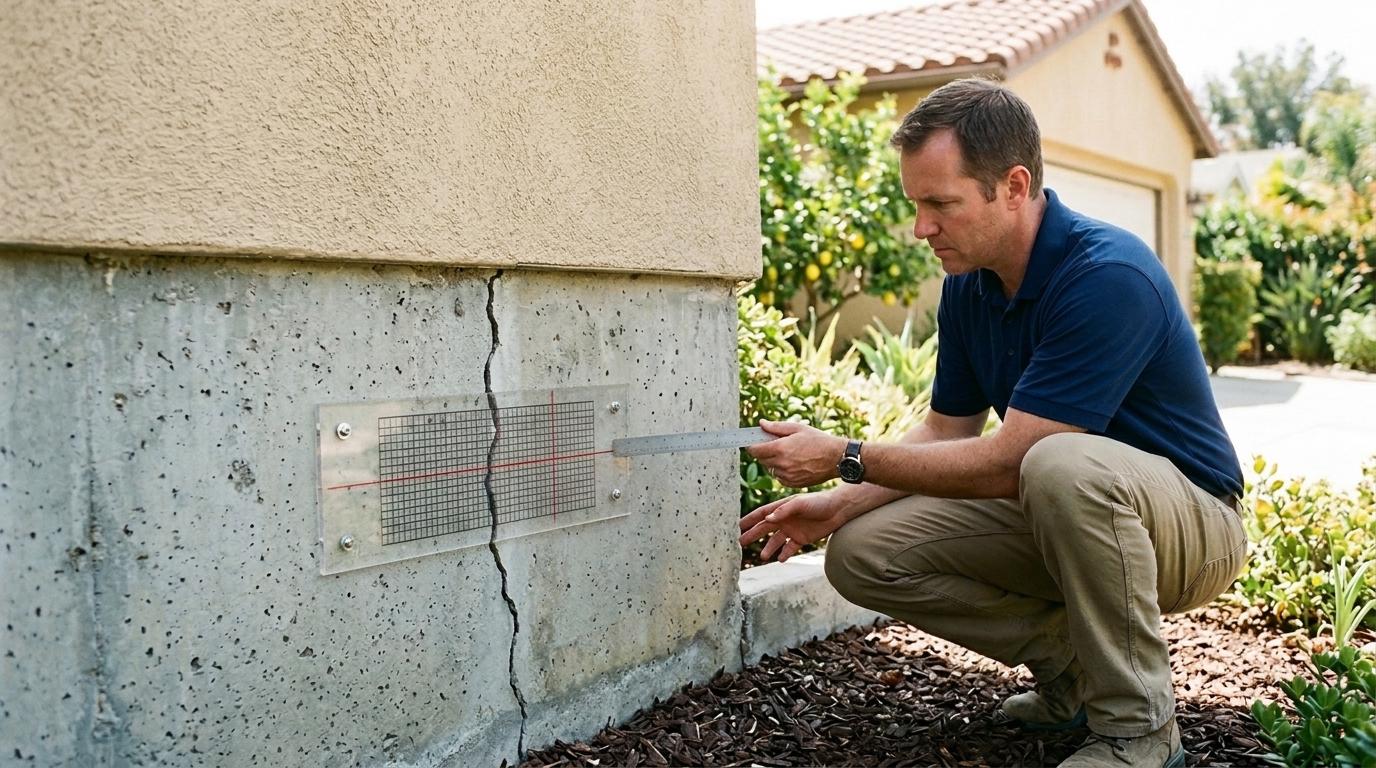
How tell-tale crack monitors track active settlement in Los Angeles homes, the red flags of a distressed foundation, and why a paid instrumental inspection pays for itself.
Table of Contents
- Why Los Angeles and Southern California Foundations Move
- How Tell-Tale Crack Monitors Work
- When Monitoring Is NOT Enough: Signs of a Distressed Foundation
- The Hidden Blind Spot of DIY Crack Monitoring
- Why a Paid Instrumental Foundation Inspection Pays for Itself
- Stop Guessing About Your Foundation
- Frequently Asked Questions
It almost always starts the same way. On a quiet Sunday morning, you walk down the side yard of your home in Pasadena, Sherman Oaks, or Whittier and notice a jagged crack running down the concrete stem wall—or a diagonal hairline fracture creeping out from the corner of a hallway doorway. You pause, take a photo on your phone, tell yourself you will keep an eye on it, and maybe even swipe a little caulk or stucco patch over it before guests come over.
Six months later—right after a wet Southern California winter storm or a long stretch of dry Santa Ana heat—the patch splits right back open. Now you are staring at a question every California homeowner dreads: is my house simply breathing with the seasons, or is my foundation actively failing?
Your eyes cannot answer that question. Memory cannot answer it either. Even phone photos taken from slightly different angles distort width and shift. That is where precision crack monitoring—and, more importantly, knowing when monitoring is no longer enough—becomes the difference between a calm, inexpensive drainage fix and a five-figure structural emergency.
Why Los Angeles and Southern California Foundations Move
Across Greater Los Angeles, Orange County, and the Inland Empire, homes sit on some of the most restless residential ground in the country. Even a well-built house can show signs of stress decades after construction because of four local forces:
- Expansive clay soils: Neighborhoods across the San Fernando Valley, San Gabriel Valley, Glendale, and Orange County sit on moisture-sensitive clay. When atmospheric river rains saturate the ground, clay swells upward with immense force; during dry summer months, it shrinks away from footings, leaving voids underneath. See our deep dive on expansive clay soil foundation problems.
- Hillside cut-and-fill lots: In hillside communities from the Hollywood Hills and Silver Lake to Arcadia and Diamond Bar, one side of a house often rests on solid cut bedrock while the downhill side sits on compacted fill soil that gradually consolidates over decades.
- Plumbing and drainage failures: A broken clay sewer line, a leaking under-slab supply pipe, or downspouts dumping roof runoff directly beside a perimeter stem wall will soften bearing soil in one localized spot and pull a single corner down.
- Seismic stress and aging concrete: Pre-1970s Southern California homes often have shallow, lightly reinforced footings that have absorbed decades of minor tremors alongside everyday soil cycles—especially homes that have never had earthquake retrofitting or foundation bolting.
The tricky part is that old, dormant cracks and active, dangerous cracks can look identical on day one. Without objective data, homeowners routinely make one of two costly mistakes: ignoring an active structural failure until framing and plumbing tear apart, or paying $30,000+ to underpin a crack that stopped moving twenty years ago.
How Tell-Tale Crack Monitors Work
When engineers and structural specialists need hard proof of whether a foundation crack is still moving, they do not guess—they install a tell-tale crack monitor (also called an acrylic crack gauge).
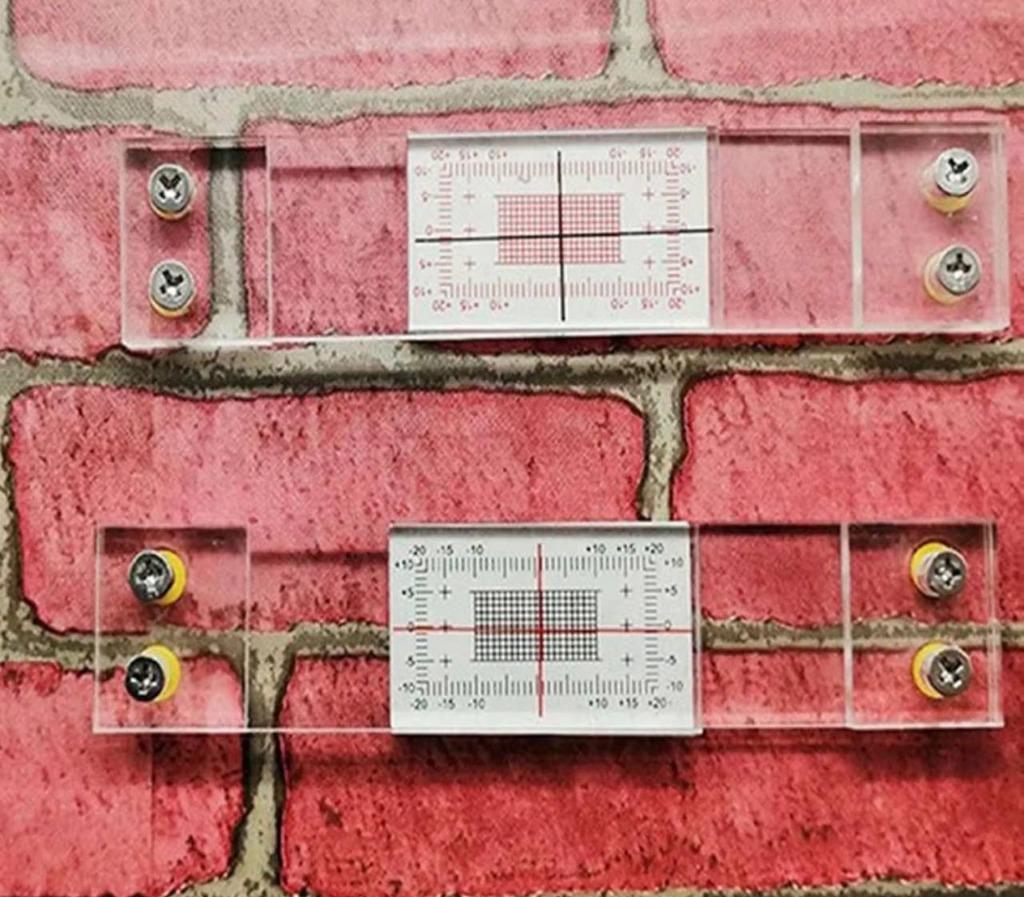
A standard tell-tale gauge consists of two overlapping clear acrylic plates anchored on opposite sides of a crack using masonry screws or structural epoxy:
- The bottom plate carries a precision millimeter grid (typically measuring up to ±20 mm horizontally and ±10 mm vertically).
- The top plate slides independently over the grid and carries a crisp crosshair cursor.
- When installed, the crosshair is zeroed at the center of the grid. Every 30 days—and after any major rainstorm or earthquake—you log the crosshair position.
In a single glance, the gauge separates three completely different structural stories:
- Dormant (static) crack: The crosshair stays locked at zero across both wet and dry seasons. The crack is historical. It may simply need epoxy crack injection and foundation waterproofing to keep moisture and rebar corrosion out, not structural underpinning.
- Seasonal (cyclic) movement: The crosshair opens a millimeter or two in late summer and closes back toward zero after winter rains. The foundation is reacting to clay moisture swings—meaning drainage correction, root barriers, or soil moisture stabilization is usually the right first move.
- Progressive (active) settlement or shear: The crosshair drifts steadily in one direction—widening horizontally, stepping vertically, or both—without returning. That is proof of active structural distress.
When Monitoring Is NOT Enough: Signs of a Distressed Foundation
Crack monitors are powerful diagnostic tools, not a substitute for structural triage. Putting a $15 plastic gauge on a failing foundation and waiting six months to "see what happens" is like putting a thermometer on a house fire.
Call for an immediate structural foundation inspection if you see any of these red flags of a distressed or emergency foundation:
- Wide or rapidly growing cracks: Exterior concrete stem wall cracks wider than 1/4 inch, or interior drywall cracks that visibly lengthen after a single rainy week.
- Horizontal cracking or bowing walls: Horizontal fractures along a stem wall, crawl space wall, or retaining wall signal lateral earth and hydrostatic water pressure pushing the wall inward.
- Stair-step cracking with lateral offset: One side of a concrete block, brick, or stem wall shifting outward or downward relative to the other side.
- Sudden framing symptoms: Doors that used to latch smoothly now jamming overnight, windows binding in their tracks, or fresh gaps opening between baseboards and hardwood floors.
- Spalling concrete and exposed rusted rebar: Flaking, crumbling stem wall faces—covered in our guide to spalling concrete and crumbling foundation repair in Los Angeles—mean the concrete is losing structural capacity from the inside out.
- Hillside slope creep or chimney separation: A chimney pulling away from the roofline, or downhill deck piers tilting after heavy rain.
For more warning signs specific to Southern California homes, review our checklist of signs of foundation problems in SoCal.
The Hidden Blind Spot of DIY Crack Monitoring
Even when a foundation is not in immediate crisis, relying on a crack monitor alone leaves a massive blind spot: *a crack gauge only tells you that* a single spot moved. It never tells you why it moved, or what the rest of the house is doing.**
We regularly inspect homes across Los Angeles where a homeowner tracked one small exterior crack for a year, completely unaware that an interior girder needed structural wood repair over a damp crawl space soil pocket, or that the back corner of the slab had already dropped 1.8 inches due to a buried downspout discharge line.
And there is another trap homeowners run into: the "free foundation estimate." Many large foundation franchises send out a commissioned salesperson rather than a licensed structural builder. The visit is free, no real elevation baseline is documented, and the proposal lands in your inbox the same afternoon recommending 16 to 24 steel piers for $40,000+—whether your home actually needs them or not.
Why a Paid Instrumental Foundation Inspection Pays for Itself
If you want unbiased truth instead of a sales pitch, you need an instrumental structural foundation inspection performed by a California licensed contractor who measures first and recommends second.
At PiersPro, our paid instrumental foundation inspection starts at $250—and 100% of that inspection fee is credited toward your repair if you hire us for the work. (For smaller quick checks without a written report or crawl space entry, a visual inspection starts at $99, though homes with active cracks or settlement almost always benefit from the full instrumental survey.)
| DIY Visual Check | Crack Monitor Alone | PiersPro Paid Instrumental Inspection (from $250) | |
|---|---|---|---|
| Measures floor slope across rooms | No | No | Yes — 1/10th-inch elevation survey |
| Distinguishes active vs. old cracks | Guesswork | Tracks 1 crack over months | Forensic crack log + baseline gauge plan |
| Finds the root cause (soil, water, framing) | No | No | Yes — crawl space, slab edge & drainage audit |
| Detects urgent / distressed conditions | Often missed | Too slow for emergencies | Immediate structural triage |
| Written report & itemized repair scope | No | No | Yes — usable for planning, second opinions, or escrow |
| Sales pressure | N/A | N/A | Zero — objective measurements first |
What You Receive During a PiersPro Inspection
- Whole-House Floor Elevation Survey: Using a digital precision altimeter (ZipLevel), we map relative elevations across your rooms to 1/10th of an inch. That contour map reveals immediately whether your slab or raised floor is flat, bowing in the center (framing), tilting as a plane (perimeter settlement), or dropping sharply at a single corner (localized water or fill issue).
- Forensic Crack Assessment & Monitoring Plan: We measure crack widths, vertical/lateral offsets, and fracture geometry across concrete stem walls, slabs, stucco, and interior finishes. Where monitoring is the smartest move, we tell you exactly where to place tell-tale gauges and what movement thresholds trigger action.
- Crawl Space, Footing & Drainage Audit: We inspect under-house concrete strength, girders, posts, pier blocks, anchor bolts, moisture levels, exterior grading, French drains and surface drainage, and retaining walls so you never treat a symptom while ignoring the cause.
- Clear Written Report & Line-Item Estimate: You walk away with documented measurements, photos, a plain-English diagnosis, and an honest verdict: monitor only, seal stable cracks with [epoxy injection](/blog/foundation-crack-repair-los-angeles-epoxy-injection), fix drainage first, or stabilize with engineered [foundation repair](/services/foundation-repair) and [helical piers](/services/helical-piers).
For a full breakdown of inspection tiers and what drives pricing in Southern California, see our guide to foundation inspection costs in Los Angeles.
Stop Guessing About Your Foundation
A small crack caught early might take a $1,800 drainage correction—or simple documented monitoring that gives you total peace of mind. Left unmeasured for two more rainy seasons, that same active corner can easily grow into a $15,000–$30,000 underpinning and interior restoration project.
Whether you have noticed a suspicious new crack, want tell-tale monitors set up on a proper engineering baseline, or need an urgent evaluation of a distressed foundation anywhere in Los Angeles, the San Gabriel Valley, the San Fernando Valley, or Orange County, start with real measurements—not guesswork.
Book your instrumental foundation inspection today. The written report starts at $250 and is 100% credited toward repair if structural work is needed.
Frequently Asked Questions
Q1: How long should you monitor a foundation crack with a tell-tale gauge?
A1: For non-urgent hairline cracks, a meaningful monitoring cycle spans at least 6 to 12 months so it captures both a Southern California dry season and a winter rainy season. However, if a crack widens by more than 1–2 mm in a few weeks, shows vertical offset, or appears alongside sticking doors and sloping floors, do not wait—book an instrumental inspection immediately.
Q2: Can I just caulk or epoxy a foundation crack myself?
A2: Patching a crack hides the symptom without telling you whether the foundation is still moving. If the crack is active, caulk and stucco patch will split open again, and rigid epoxy crack injection can actually cause a new parallel crack to form beside the old one. Always verify whether movement is active before sealing.
Q3: Why pay $250 for a foundation inspection when other companies offer "free estimates"?
A3: A free estimate is usually a sales call designed to sell piers, rarely includes a full written elevation contour map, and carries an obvious incentive to recommend expensive work. A paid instrumental inspection buys you an independent, documented baseline—floor elevations to 1/10th of an inch, crawl space and drainage findings, and an honest answer even when the right recommendation is "monitor it and fix your gutters." Plus, if you hire PiersPro for repairs, 100% of the inspection fee is credited to your project.
Q4: Is a contractor foundation inspection the same as a structural engineer's letter?
A4: No. A licensed contractor's instrumental inspection gives you elevation measurements, crack documentation, root-cause diagnosis, and an itemized repair estimate. If a distressed foundation requires structural underpinning, city permits, or a lender-mandated stamped letter, we coordinate directly with a California-licensed structural engineer using our baseline survey data.
Prices and ranges in this article are approximate and for planning only, and every project is priced individually. The final cost is determined only after an on-site estimate and may differ from the figures shown on this site.
Permit rules, fees, codes and deadlines vary by city and county and change over time. Please confirm the details with the building department of your city or county before starting work.
About the author: This article was prepared by the PiersPro team. PiersPro is a d/b/a of SKILL SEE SERVICES INC, a California licensed contractor (Class B, CSLB #1110475). Verify the license on the CSLB website.