
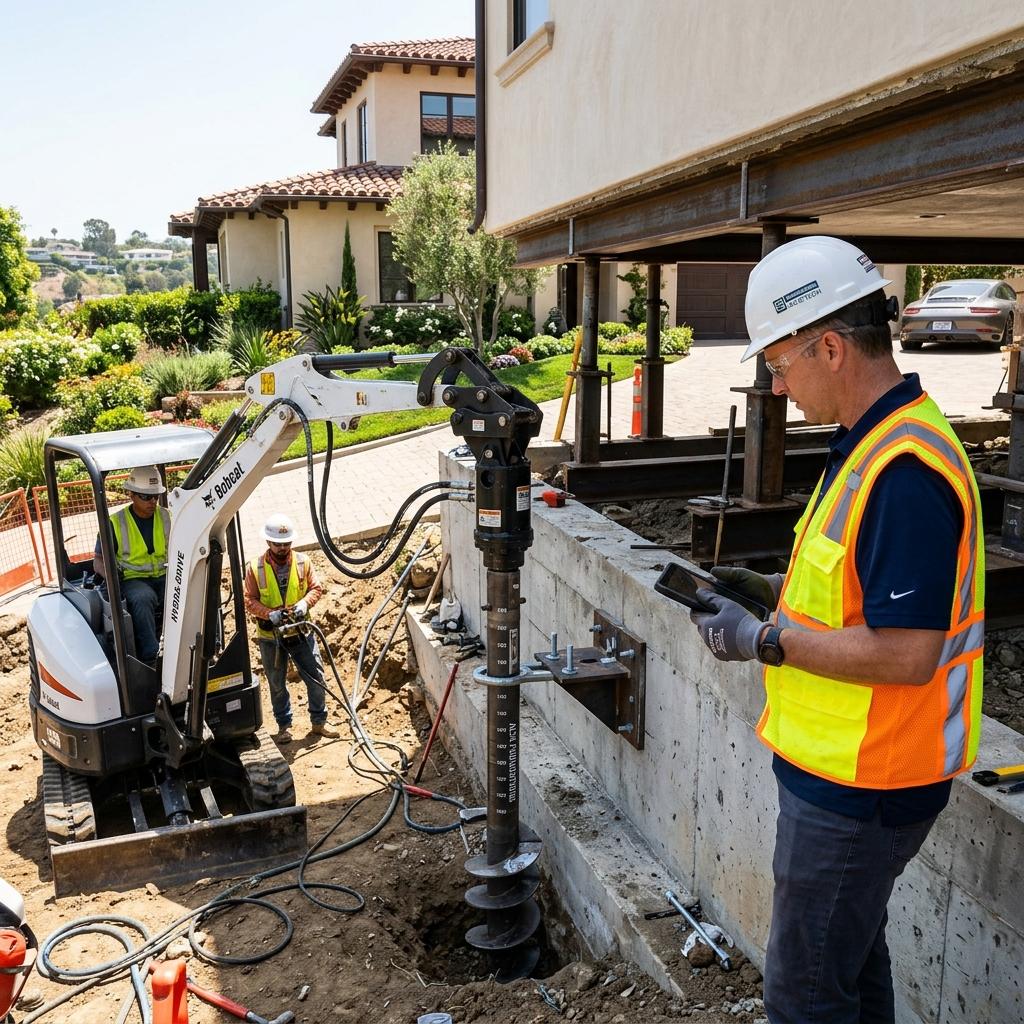
Discover typical foundation settlement issues in Inland Valley foothill communities. Learn how expansive soils and water runoff affect local footings.
Table of Contents
The Inland Valley foothill communities—including Claremont, La Verne, and Pomona—experience specific soil-driven foundation challenges. Built near the base of the San Gabriel Mountains, homes in these areas rest on a mixture of rocky foothill alluvial deposits and highly expansive clay soils that shift during seasonal weather changes.
At PiersPro (CA GC License #1110475), we provide professional foundation repair and seismic retrofitting across the Inland Valley. This guide details typical structural issues in the Claremont, La Verne, and Pomona areas.
Expansive Foothill Soils and Runoff
The foothills experience unique hydrological conditions. Rain runoff from the San Gabriel Mountains saturates soils near Pomona and La Verne:
- Soil Expansion: Clay soils expand when wet, exerting upward pressure on concrete footings.
- Foothill Settling: In drier months, soil shrinkage causes uneven footing settlement.
- Historic Framing: Claremont and Pomona feature historic bungalows with unbolted mudsills that require seismic retrofitting.
To protect these properties, we install foundation bolting, helical piers, and French drains.
Do you live in Claremont, La Verne, or Pomona and notice slope issues or cracks?
Get an honest, engineering-based evaluation. PiersPro offers a detailed on-site inspection from $99 (credited to your contract).
Schedule an Inland Valley Inspection or call (213) 583-6669 to speak with our local team.
What We Check on an Inland Valley Lot
Homes at the base of the San Gabriel Mountains sit on alluvial fan deposits: layers of gravel, sand and clay washed down from the canyons. The mix changes from one lot to the next, so two neighbors can have very different foundation behavior. An on-site inspection looks at four things in this order:
- Where the water goes. Roof downspouts, yard grading and any slope above the house.
- Floor levels. Measured elevation readings show which part of the house has moved and by how much.
- The concrete. Crack width, offset and pattern on the stem wall or slab edge.
- The crawl space. Posts, girders, moisture and whether the sill plate is bolted.
| What you see | Likely cause on foothill lots | First step |
|---|---|---|
| Cracks that open in summer and close in winter | Clay shrinking and swelling | Even out soil moisture, monitor |
| One corner lower than the rest | Settlement on fill or wet soil | Elevation survey, possible piers |
| Damp crawl space after rain | Runoff reaching the footing | Drainage correction |
| No bolts on the sill plate | Pre-code construction | Seismic retrofit |
Repair Order: Water First, Structure Second
On clay and alluvial soils the usual sequence is drainage, then structural support, then cosmetic repair. Underpinning a footing while runoff still soaks the soil next to it only moves the problem to the next section of wall. Claremont's position near the Cucamonga Fault also makes it worth checking bolting and bracing at the same visit, because the crawl space is already open.
Frequently Asked Questions (FAQ)
Q1: Does Claremont require geological surveys for repairs?
A1: For standard pier underpinning, the Claremont Building Division typically allows repairs based on structural engineering drawings without requiring a custom site-specific geological report, unless the home is on a steep hillside slope.
Q2: How does a French drain help clay soils in Pomona?
A2: A French drain captures mountain slope runoff and redirects it away from your foundation footing, keeping clay soil moisture levels uniform and preventing differential swelling.
Q3: Is seismic retrofitting worth it for older Claremont homes?
A3: For raised-foundation homes built before modern codes, usually yes. Claremont sits near the Cucamonga Fault, and unbolted sill plates and unbraced cripple walls are the two weak points a retrofit corrects from inside the crawl space.
Q4: What does a foundation inspection cost in the Inland Valley?
A4: A visual inspection starts at $99. That is the minimum price; a crawl space check, instrumental survey and written report are add-ons priced by the calculator on the inspection page. The fee is credited toward repair.
Prices and ranges in this article are approximate and for planning only, and every project is priced individually. The final cost is determined only after an on-site estimate and may differ from the figures shown on this site.
Permit rules, fees, codes and deadlines vary by city and county and change over time. Please confirm the details with the building department of your city or county before starting work.
About the author: This article was prepared by the PiersPro team. PiersPro is a d/b/a of SKILL SEE SERVICES INC, a California licensed contractor (Class B, CSLB #1110475). Verify the license on the CSLB website.